
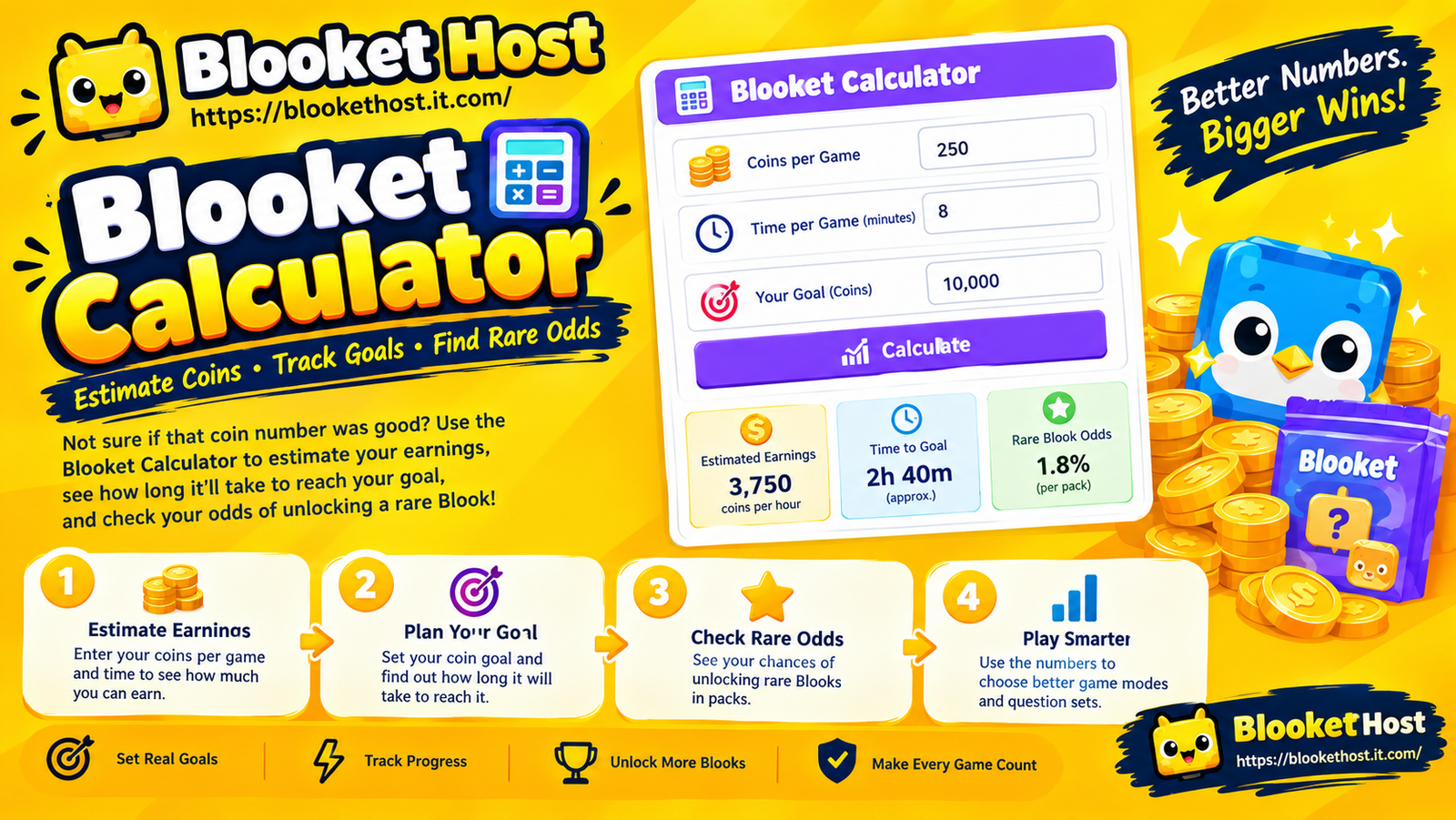
You finish a Blooket game, a coin number pops up on your screen, and you have no idea whether that was a good result or how to earn more next time. If that sounds familiar, you’re exactly who this guide is for. Learning how to use a Blooket calculator turns that confusing coin number into something actually useful — an estimate of your earnings, a timeline to your next goal, and even a sense of your odds of unlocking a rare Blook. The calculator above this article does all three, and this guide walks through how to get the most out of it.
Why a Coin Number Alone Doesn’t Tell You Much
The token total you see at the end of a game is just a raw number — it doesn’t tell you whether that was a strong result for the mode you played, how it compares to what you’d earn in a different mode, or how close it actually puts you to a specific pack you’re saving for. That context is exactly what a calculator adds. Instead of staring at a number in isolation, you get a clearer picture of what it actually means for your progress.
What the Blooket Calculator Actually Does
At its core, a token calculator like the one on this page helps with three things:
- Estimating earnings — projecting how many tokens you’re likely to earn based on factors like game mode, session length, and accuracy.
- Tracking goals — showing how many more games (or how much more time) it will take to reach a specific token target, like the cost of a themed pack you’re eyeing.
- Estimating pack odds — giving you a realistic sense of how many pack openings it typically takes to land a specific rarity tier, so you’re not assuming a Legendary pull is coming any sooner than it actually is.
Rather than guessing at your progress or grinding without a clear target, the calculator turns vague effort into a plan you can actually follow.
Step 1: Input Your Current Token Count
Start by entering your current token balance — this is the baseline the calculator uses for every other estimate. You’ll find this number on your dashboard, usually displayed near the top of the screen. Getting this right matters, since an inaccurate starting point throws off every projection that follows.
Step 2: Set Your Target
Next, decide what you’re actually calculating toward. This is usually one of two things:
- A specific pack you want to afford, in which case you’ll enter that pack’s token cost as your target.
- A general savings goal, if you’re not chasing anything specific yet and just want a sense of how your token balance is trending over time.
Having a clear target is what turns the calculator from a novelty into something genuinely useful — without one, you’re just looking at numbers with no context for what they mean.
Step 3: Factor In Your Play Style
This is where the calculator gets more personalized. A few inputs typically affect the estimate:
- Live games vs. solo play — since live sessions tend to earn tokens faster due to bonus multipliers, factoring in how often you play live versus solo changes your projected timeline meaningfully.
- Accuracy rate — a rough estimate of how consistently you answer correctly, since accuracy affects earnings more than raw speed in most modes.
- Session frequency — how often you’re realistically playing, whether that’s daily, a few times a week, or only during classroom sessions.
The more honestly you input these factors, the more useful the resulting estimate becomes. Overestimating your play frequency just gives you a timeline that won’t match reality.
Reading Your Results
Once you’ve entered your inputs, the calculator typically returns a few key outputs:
- Estimated tokens per session, based on your inputted play style and accuracy.
- Sessions needed to reach your goal, translating your target into a concrete number of games rather than an abstract token count.
- Rough timeline, converting that session count into days or weeks based on how often you play.
- Pack odds context, if you’ve set a specific pack as your target, giving you a realistic sense of how many openings it typically takes to hit a rare pull.
These numbers are estimates, not guarantees — Blooket’s actual token mechanics and pack odds have some built-in randomness that no calculator can predict with certainty. What the calculator gives you is a realistic range to plan around, not a promise of an exact outcome.
Using the Calculator to Adjust Your Strategy
The real value of running these numbers isn’t just watching a projection — it’s using it to make smarter decisions about how you play. A few examples:
If your timeline looks longer than you’d like, the calculator can show you how much switching from solo play to more live games would speed things up, since live sessions generally close the gap faster.
If you’re deciding between two packs, running the numbers on both lets you compare realistically instead of guessing which one is more “worth it” based on cost alone.
If your accuracy estimate is dragging down your projection, that’s a signal worth taking seriously — it suggests spending more time with question sets you’re less familiar with before jumping into competitive live games.
A Few Things the Calculator Can’t Do
It’s worth being upfront about the limits here. The calculator can’t:
- Guarantee a specific pack pull. Pack odds are randomized per opening, and no tool can predict an individual outcome.
- Account for platform changes. If token rates or pack costs are adjusted on Blooket’s end, projections will shift accordingly, and it’s worth rechecking your numbers periodically rather than treating one calculation as permanent.
- Replace actual gameplay data. The more games you play, the more accurate your own sense of your real earning rate becomes compared to any generalized estimate.
Think of it as a planning tool, not a crystal ball — genuinely useful for setting realistic goals, but not a substitute for just playing and tracking your actual results over time.
The Bottom Line
A Blooket calculator takes the confusing coin number you see at the end of a game and turns it into something you can actually plan around — an earnings estimate, a timeline to your next goal, and a realistic sense of pack odds. Plugging in your current balance, a clear target, and an honest read on your play style gives you numbers worth trusting, even if the built-in randomness of the game means nothing is ever guaranteed. Used regularly, it turns vague grinding into an actual strategy.