
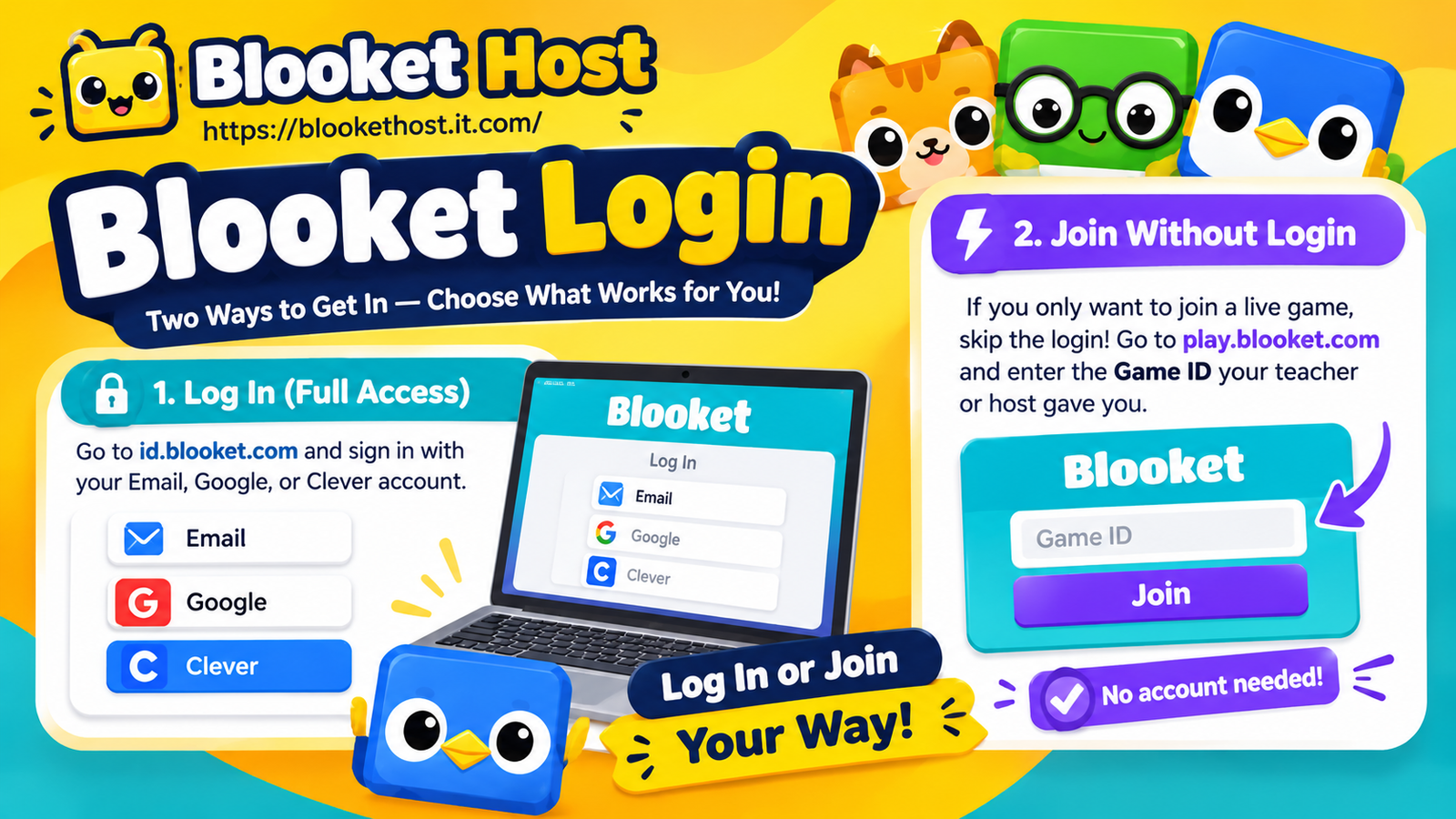
If you’re trying to figure out how to log in to your Blooket account, the short answer is simple: go to id.blooket.com and sign in with your Email, Google, or Clever account. That covers the login process for the vast majority of people. But before you go hunting for a login screen, there’s an important distinction worth knowing — if all you want to do is join a live game, you don’t need to log in at all. You can skip straight to play.blooket.com and enter the Game ID your teacher or host gave you. This guide covers both paths, so you land on the right one the first time.
Two Very Different Blooket Experiences
A lot of confusion around Blooket login comes down to one thing: people don’t realize there are two separate entry points depending on what they’re trying to do.
- id.blooket.com — for anyone who needs a full account: teachers, hosts, or students who want to save progress, host games, or access hosting tools.
- play.blooket.com — for anyone just joining a live game with a code. No account, no login, no password required.
Understanding which one applies to you before you start saves a lot of unnecessary frustration.
How to Log In at id.blooket.com
If you need to access a full Blooket account — whether to host games, manage saved question sets, or use teacher-side features — here’s the process:
- Go to id.blooket.com in your browser.
- Choose your sign-in method. You’ll typically see three options:
- Email — sign in with the email address and password associated with your account.
- Google — sign in using your existing Google account, which skips the need for a separate password.
- Clever — common in school environments, this lets you sign in using credentials your school district has already set up.
- Enter your credentials for whichever method you chose.
- You’re in. Once authenticated, you’ll land on your account dashboard, where hosting tools, saved sets, and account settings live.
The method you use often comes down to how your account was originally created. If your school set you up through Clever, trying to log in with Email credentials won’t work, and vice versa — so if login fails, the first thing to check is whether you’re using the right method for how your account was set up.
When You Don’t Need to Log In At All
This is the part that trips up a surprising number of people, especially students. If your goal is simply to join a game your teacher or a host has already started, logging in is not just unnecessary — it’s the wrong step entirely.
Instead:
- Go to play.blooket.com.
- Enter the Game ID provided by your teacher or host (usually a short numeric or alphanumeric code shown on a shared screen or sent through a link).
- Choose a username for the session.
- Join the game — no account, no password, no sign-in screen involved.
If you’ve ever seen a classmate stuck trying to “log in” just to join a quiz game, this is almost always the mix-up: they’re on id.blooket.com looking for a login form when they should be on play.blooket.com entering a code.
Common Login Issues and How to Fix Them
Wrong sign-in method selected
If your account was created through Google or Clever, trying to log in with an email/password combo will fail, even if the email address matches. Try switching sign-in methods before assuming your account is broken.
Forgotten password (Email accounts)
If you signed up with email and password, look for a “forgot password” link on the sign-in screen. This typically triggers a reset email to the address on file.
Clever login not working
Clever-based logins depend on your school’s system being active and correctly linked. If this fails, it’s often a school-side issue rather than a Blooket-side one — checking with your school’s IT department is usually the fastest fix.
Logged in but can’t find hosting tools
Some accounts are set up as student/player accounts rather than teacher/host accounts, which limits access to hosting features. If you need host-level access and don’t have it, that’s usually an account type issue rather than a login error.
Confusing id.blooket.com with play.blooket.com
As covered above, this is the single most common source of “login problems” that aren’t actually login problems at all. If you’re just trying to join a game, you’re on the wrong page if you’re seeing a login screen.
Staying Logged In vs. Logging In Each Time
Depending on your browser settings, Blooket may keep you signed in between visits, which is convenient for frequent hosts. If you find yourself having to log in every single time despite not clearing your browser data, check whether:
- Your browser is set to clear cookies on exit.
- You’re using a private/incognito window, which doesn’t retain login sessions.
- Browser extensions are blocking cookies or local storage, which some login systems rely on to remember your session.
A Quick Reference for Next Time
To avoid the back-and-forth entirely, it helps to remember this simple rule: hosting or managing an account starts at id.blooket.com; joining a game starts at play.blooket.com. Bookmarking whichever one applies to your regular use case — teacher dashboard vs. quick game join — saves time every time you come back.
Final Thoughts
Most Blooket login confusion isn’t really about broken credentials — it’s about landing on the wrong page for what you’re actually trying to do. If you need full account access for hosting or managing content, id.blooket.com with Email, Google, or Clever will get you there. If you just want to jump into a game your teacher started, skip the login screen entirely and head straight to play.blooket.com with your Game ID in hand. Knowing which path applies before you start is really the whole trick.