

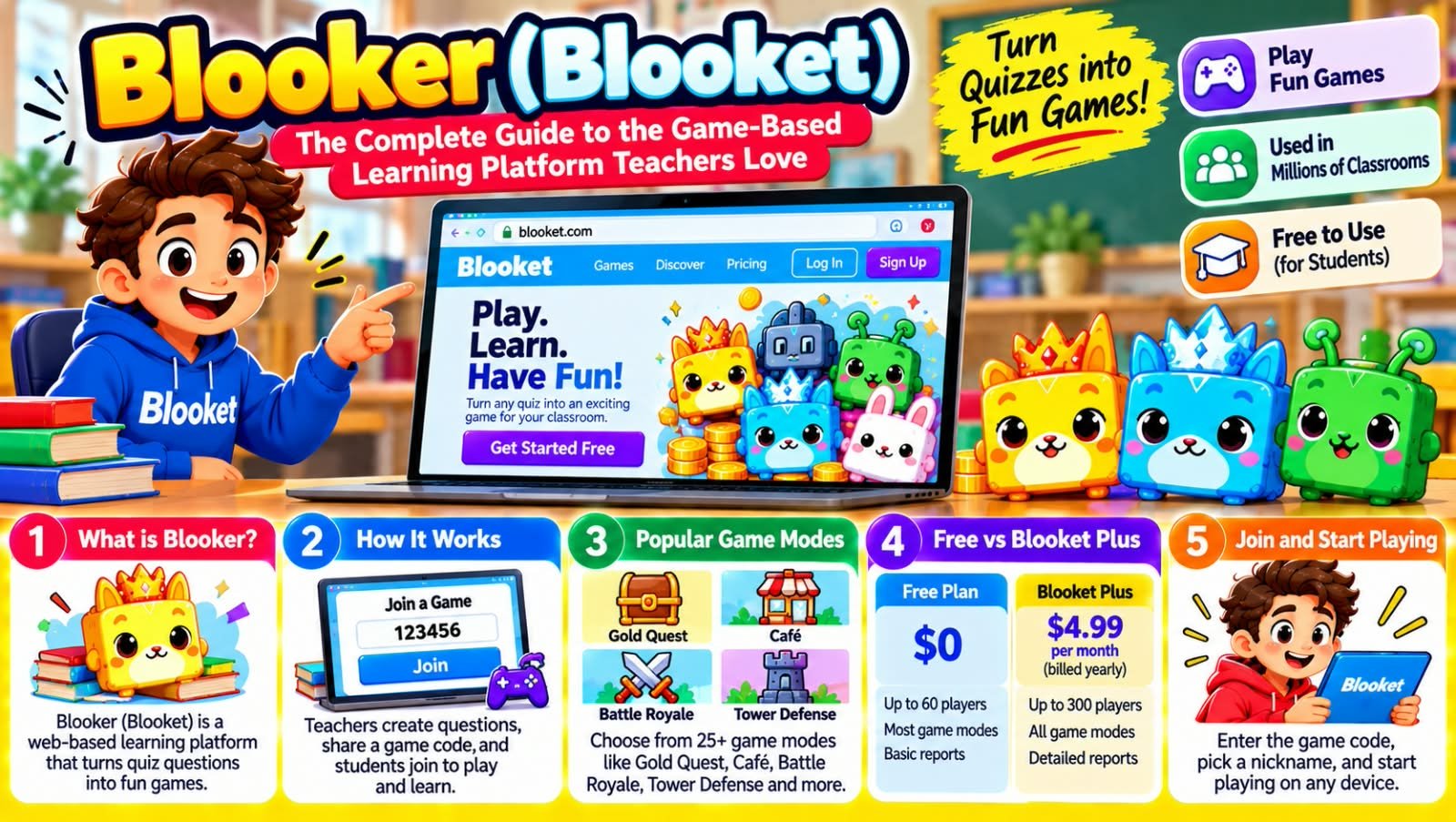
Before anything else, here’s a quick clarification. Many people type “Blooker” into Google when they actually mean Blooket, the popular game-based learning platform used in classrooms worldwide. If you searched “Blooker,” you’re in the right place — this guide covers everything about it in detail.
What Is Blooker?
Blooker, more properly known as Blooket, is a web-based learning platform that turns ordinary quiz questions into fast-paced classroom games. Instead of answering a question and simply seeing a score, players answer the same question inside a mini-game, such as a racing track, a tower defense battle, or a treasure hunt. That small twist changes everything. Students stop treating review sessions like a chore and start treating them like a game they actually want to win.
Teachers build or import a set of questions on Blooker, pick one of the platform’s many game modes, and generate a short join code. Students then enter that code on any device with a browser, pick a nickname, and the game begins. There’s no software to install and no lengthy sign-up process for players, which is part of why Blooker spread so quickly through classrooms after it launched.
Blooker (Blooket) was created by brothers Tom and Ben Stewart, and it has since grown into one of the most recognized classroom review tools alongside names like Kahoot and Quizizz.
How Does Blooker Work?
The Blooker system runs on a simple loop that repeats itself in every game mode:
- A teacher creates a question set on Blooker, either from scratch or by searching its public library of sets made by other educators.
- The teacher chooses a game mode and starts a live session, which generates a six-digit code.
- Students join the Blooker game from a browser using that code and pick a nickname or avatar, known as a “Blook.”
- Players answer the same quiz questions, but the result of each answer feeds into whatever game mode is running, whether that means earning gold, building a tower, or racing ahead on a track.
- Once the game ends, the teacher receives a report showing which questions students struggled with most.
Because everything runs in the browser, Blooker works on laptops, Chromebooks, tablets, and phones without needing an app. That flexibility makes it just as useful for remote learning and homeschooling as it is for a packed classroom.
Blooker Game Modes Explained
This is where Blooker pulls ahead of a standard quiz tool. As of 2026, the platform offers more than two dozen playable modes, and new ones are added with each seasonal update. A few of the most popular Blooker modes include:
- Gold Quest – Players answer questions to collect gold, steal from opponents, or get robbed themselves, which adds a layer of unpredictability that keeps everyone engaged until the last question.
- Tower Defense – Correct answers earn resources used to build defenses against waves of enemies, rewarding both accuracy and strategy.
- Battle Royale – A head-to-head elimination format where speed and correct answers determine who survives each round.
- Crypto Hack – Players mine tokens and can hack opponents to steal their balance, a mode many teachers use to spark conversations about digital finance.
- Racing – A straightforward sprint to the finish line based purely on how many questions a student answers correctly.
- Café and Factory – Slower-paced modes that work well for solo homework assignments or quieter mornings when the class needs an easier start.
Some Blooker modes are available to every user for free, while a smaller set is reserved for Blooket Plus subscribers. The paid modes don’t necessarily offer better rewards; they mainly add variety for teachers who run games often.
Blooker Pricing: Free vs Blooket Plus
Blooker runs on a freemium model, which means the core experience costs nothing.
Free plan
The free tier of Blooker lets teachers create unlimited question sets, host games with up to 60 players, and access around 18 of the available game modes. For most classrooms, this is more than enough.
Blooket Plus
Blooket Plus costs roughly $4.99 a month when billed annually, or about $9.99 a month on a flexible, pay-as-you-go basis. It unlocks all game modes on Blooker, raises the player limit to 300, adds detailed performance reports, folders for organizing sets, and audio questions for younger learners or students with reading difficulties.
Group and school plans
Larger schools and departments can buy bulk Blooker licenses, with pricing that scales based on the number of teacher seats needed. These plans are aimed at administrators who want every teacher in a building or district working from the same paid account.
For an individual teacher who just wants to run a review game once in a while, the free Blooker plan covers nearly everything needed. Plus becomes worth considering once games become a weekly habit.
How to Join a Blooker Game
Joining a Blooker game as a student takes less than a minute:
- Go to the Blooker join page in any browser.
- Enter the game code your teacher shared, usually written on the board or shared on screen.
- Choose a nickname, or in some modes, pick a Blook avatar.
- Wait for the teacher to start the game, then begin answering questions as they appear.
No account or email address is required to join a Blooker game as a player, which removes one of the biggest friction points teachers run into with other classroom tools.
Is Blooker Safe for Students?
Yes. Blooker doesn’t require students to create personal accounts to play, and nicknames are the only identifying detail shown during a game. Teachers who build their own question sets keep full control over the content students see, and the Blooker public library is widely used across schools without major safety complaints. As with any classroom tool, it’s still good practice for teachers to review a question set before assigning it, especially one made by another user.
Blooker vs Kahoot vs Quizizz
These three platforms often get compared because they solve a similar problem in different ways.
Kahoot focuses heavily on fast, colorful multiple-choice rounds with music and a leaderboard, which works great for quick energy boosts but offers less gameplay variety. Quizizz leans more toward self-paced, homework-style review with strong reporting features. Blooker sits in the middle, combining live competitive play with actual mini-games rather than just a scoreboard.
The right choice usually comes down to teaching style. A teacher who wants short bursts of energy might prefer Kahoot. One who wants detailed data on independent practice might lean toward Quizizz. A teacher who wants students fully immersed in a game while still reviewing material tends to land on Blooker.
Tips for Getting the Most Out of Blooker
- Match the game mode to the mood of the room. High-energy Blooker modes like Battle Royale work well right after lunch, while calmer modes like Café suit the start of class.
- Keep question sets short for younger students so games don’t drag on and lose attention.
- Use the post-game report to spot which questions tripped up the most students, then revisit those topics before the next lesson.
- Assign solo modes as homework when class time is tight, since several Blooker modes work fine without a live host.
- Rotate game modes regularly. Students lose interest in a mode they’ve played a dozen times, even if the questions themselves change.
Frequently Asked Questions
Is Blooker the same as Blooket?
Yes. “Blooker” is simply a common misspelling of Blooket, the actual name of the platform. Both refer to the same game-based learning tool.
Is Blooker free to use?
Yes. The free plan covers unlimited question sets, hosting for up to 60 players, and access to most game modes. Blooket Plus adds extra modes, higher player limits, and detailed reports for a monthly fee.
Do students need an account to play Blooker?
No. Students only need the game code and a nickname to join. Teachers need an account to create and host games.
What is the most popular Blooker game mode?
Gold Quest and Tower Defense are consistently among the most played modes, thanks to their mix of strategy and unpredictability.
Can Blooker be used for homework?
Yes. Several modes, including Factory and Café, are designed to work without a live host, which makes them suitable for independent or at-home practice.
Is Blooker better than Kahoot?
Neither is strictly better. Blooker offers more game variety through its mini-games, while Kahoot is known for quick, high-energy rounds. The better fit depends on how a teacher wants to use class time.
How many players can join a Blooker game?
Free accounts support up to 60 players per game, while Blooket Plus raises that limit to 300.
Final Thoughts
Blooker (Blooket) earned its popularity by solving a problem most review games never quite cracked: keeping students engaged through repetition. Turning quiz questions into actual games, rather than just another scored quiz, gives students a reason to care about getting the right answer beyond a grade. Whether a teacher is running a quick five-minute review or planning an entire lesson around game-based learning, Blooker’s mix of free access, variety, and simplicity explains why so many classrooms keep coming back to it.
Explore More:
Blook, Blick It and Blookey Explained: The Full Blooket Guide
