

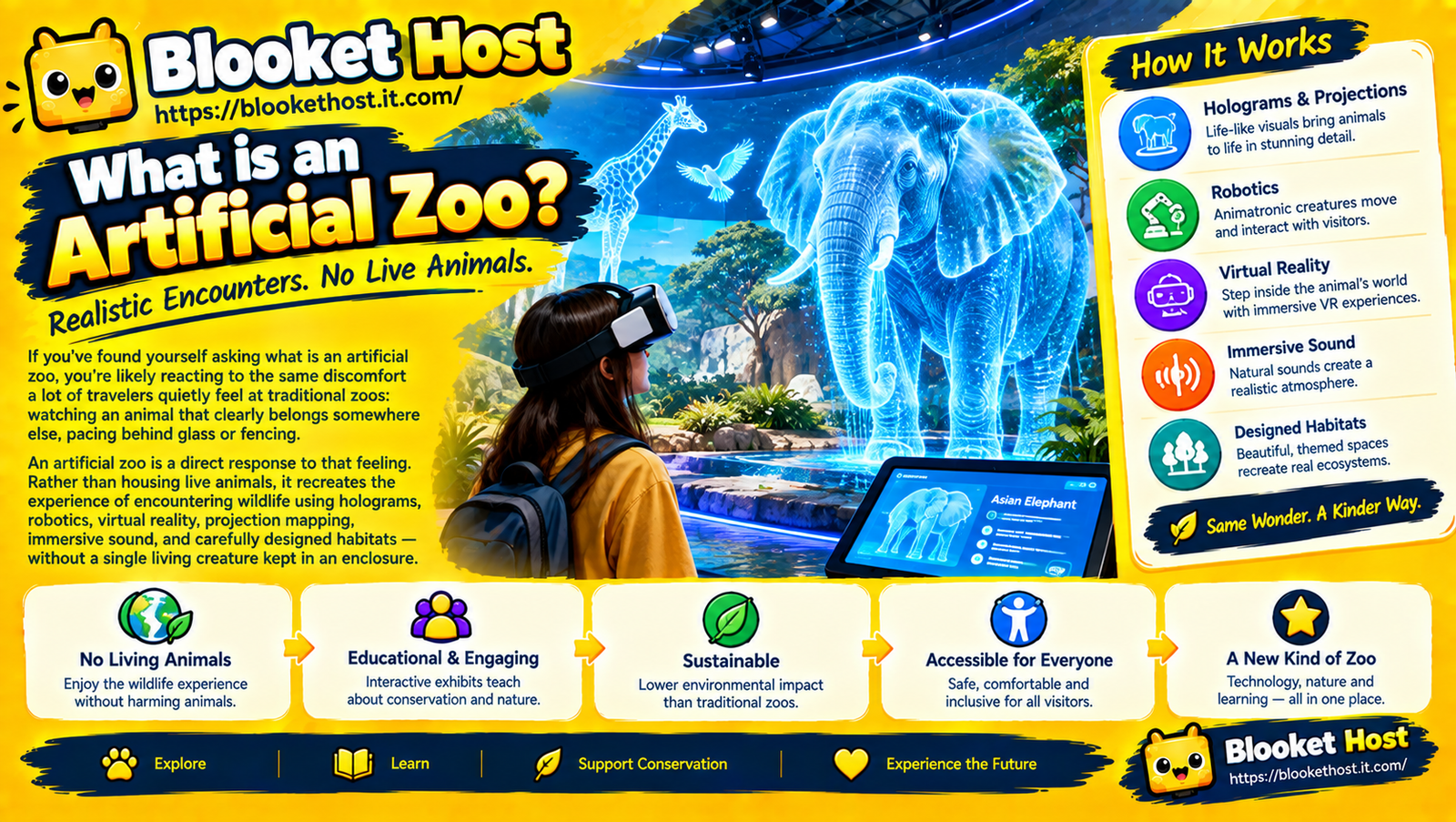
If you’ve found yourself asking what is an artificial zoo and how does it work, you’re likely reacting to the same discomfort a lot of travelers quietly feel at traditional zoos: watching an animal that clearly belongs somewhere else, pacing behind glass or fencing. An artificial zoo is a direct response to that feeling. Rather than housing live animals, it recreates the experience of encountering wildlife using holograms, robotics, virtual reality, projection mapping, and immersive sound — without a single living creature kept in an enclosure. This isn’t a hypothetical concept either; these attractions already exist and are actively expanding across multiple countries.
The Core Idea Behind Artificial Zoos
Traditional zoos solve the problem of “how do people see wildlife they’d otherwise never encounter” by physically housing animals. Artificial zoos solve the same problem differently: instead of bringing the animal to the visitor, they simulate the animal convincingly enough that the experience feels similar, without any of the ethical, logistical, or welfare complications that come with keeping wild species in captivity.
The technology behind this varies by attraction, but generally combines a few core elements:
- Holographic or laser-projected animals that appear three-dimensional as you walk through a themed space.
- Augmented reality (AR) layered into a physical environment, rather than fully isolating visitors behind a screen or headset.
- Motion and interactivity, where animals respond to visitor movement or presence rather than playing on a fixed loop.
- Immersive sound and lighting design built to reinforce the sense of being somewhere else entirely — a rainforest, an arctic tundra, a coral reef.
Real Examples Already Operating
This concept moved from novelty to genuine attraction fairly quickly. A few notable examples:
Hologram Zoo, Brisbane. Widely credited as the first of its kind, this Australian attraction opened in December 2022 and was later named one of Time Magazine’s “Best Inventions” of 2023. It uses laser light to project three-dimensional animals across themed zones — Africa, Australia, the Arctic, and a dinosaur section — where visitors can walk directly through the projections.
Zoocade, Austin, Texas. The first hologram zoo in the United States, opened in early 2025 by the same underlying technology (developed by Axiom Holographics). It features a long holographic tunnel where guests wearing 3D glasses encounter elephants, giraffes, hippos, and prehistoric animals, alongside smaller themed rooms and an attached arcade.
Hologram Zoo, Zug, Switzerland. One of the few European locations, alongside a sister site in Copenhagen, bringing the same concept to a shopping-center setting — visitors can walk among projected koi, cherry blossoms, pandas, and cranes in a themed indoor space.
Similar attractions in China and Canada, following the same underlying model as it continues to expand internationally.
Across all of these, the common thread is the same: guests wearing 3D glasses walk through a themed tunnel or room where animals appear to move, react, and sometimes even “interact” — some setups let visitors hold out a hand as though feeding a holographic animal, which responds accordingly.
Why Interest in This Concept Is Growing
A few factors are driving genuine momentum behind artificial zoos rather than this staying a novelty gimmick:
Animal welfare concerns. A significant and growing share of visitors have real reservations about keeping wild animals in captivity, particularly species known to suffer from small enclosures or unnatural climates. An artificial zoo sidesteps this concern entirely, since there’s no living animal involved at any point.
Weather and scheduling reliability. One of the most-cited practical frustrations with traditional zoos is that live animals often aren’t visible — too hot, too cold, hiding, sleeping. Because artificial zoos don’t rely on an animal’s actual behavior, the experience is consistent every single visit, regardless of weather or time of day.
Access to extinct or otherwise unavailable species. Because nothing being shown is a real living creature, artificial zoos can feature dinosaurs and other extinct animals alongside modern wildlife, something no traditional zoo could ever offer.
Lower ongoing operational complexity. Without live animals, there’s no need for the extensive feeding, veterinary care, and specialized habitat maintenance that traditional zoos require — which changes both the cost structure and the ethical questions involved in running the attraction.
How It Compares to Traditional Zoos
It’s worth being fair to both sides here rather than treating this as a simple replacement.
What traditional zoos still offer that artificial zoos don’t: many accredited zoos run genuine conservation and breeding programs for endangered species, along with real scientific research and education tied to living animals — value that a projection, however realistic, can’t replicate.
What artificial zoos offer that traditional zoos structurally can’t: a wildlife experience entirely free of captivity concerns, consistent animal “presence” regardless of weather or animal mood, and access to species that no longer exist or would never be ethical or practical to house physically.
Rather than one clearly superseding the other, most current commentary treats these as offering genuinely different things — a traditional zoo focused on conservation and real animal encounters, and an artificial zoo focused on an immersive, guilt-free visual experience.
What a Visit Typically Looks Like
While specifics vary by location, most current artificial zoos follow a similar format:
- 3D glasses are issued at entry, since the holographic effect typically depends on them for the full three-dimensional illusion.
- Visitors walk through a themed tunnel or series of rooms, often organized by region (Africa, Australia, Asia, Arctic) or by concept (a dinosaur zone, an underwater zone).
- Animals appear to move through the space in real time, sometimes reacting to visitor movement or proximity.
- Sessions typically run 20–40 minutes, often followed by an attached gift shop, arcade, or additional themed experience depending on the specific venue.
Is This the Future of Zoos, or a Complement to Them?
Most current signals point toward artificial zoos functioning as a complement to traditional zoos rather than a wholesale replacement — at least for now. Conservation-focused institutions still play a role that a projection can’t fill, while artificial zoos are carving out their own space as a distinct entertainment and educational format, particularly appealing to visitors specifically seeking an animal-free alternative. As the underlying technology continues to expand into new cities, it’s reasonable to expect this category to keep growing alongside, rather than instead of, traditional wildlife attractions.
The Bottom Line
An artificial zoo replaces live animals with holographic, robotic, or AR-driven simulations convincing enough to recreate the feeling of encountering wildlife — and this isn’t a distant concept, it’s already operating in cities including Brisbane, Austin, Zug, and Copenhagen, with more locations expanding each year. The appeal comes down to a few consistent factors: no captivity concerns, no weather-dependent animal visibility, and access to species — including extinct ones — no traditional zoo could ever offer. Whether you see it as a genuine alternative or simply a fascinating complement to conservation-focused zoos, it’s a concept worth understanding now, given how quickly it’s already moved from a single Australian attraction to a growing international format.
