

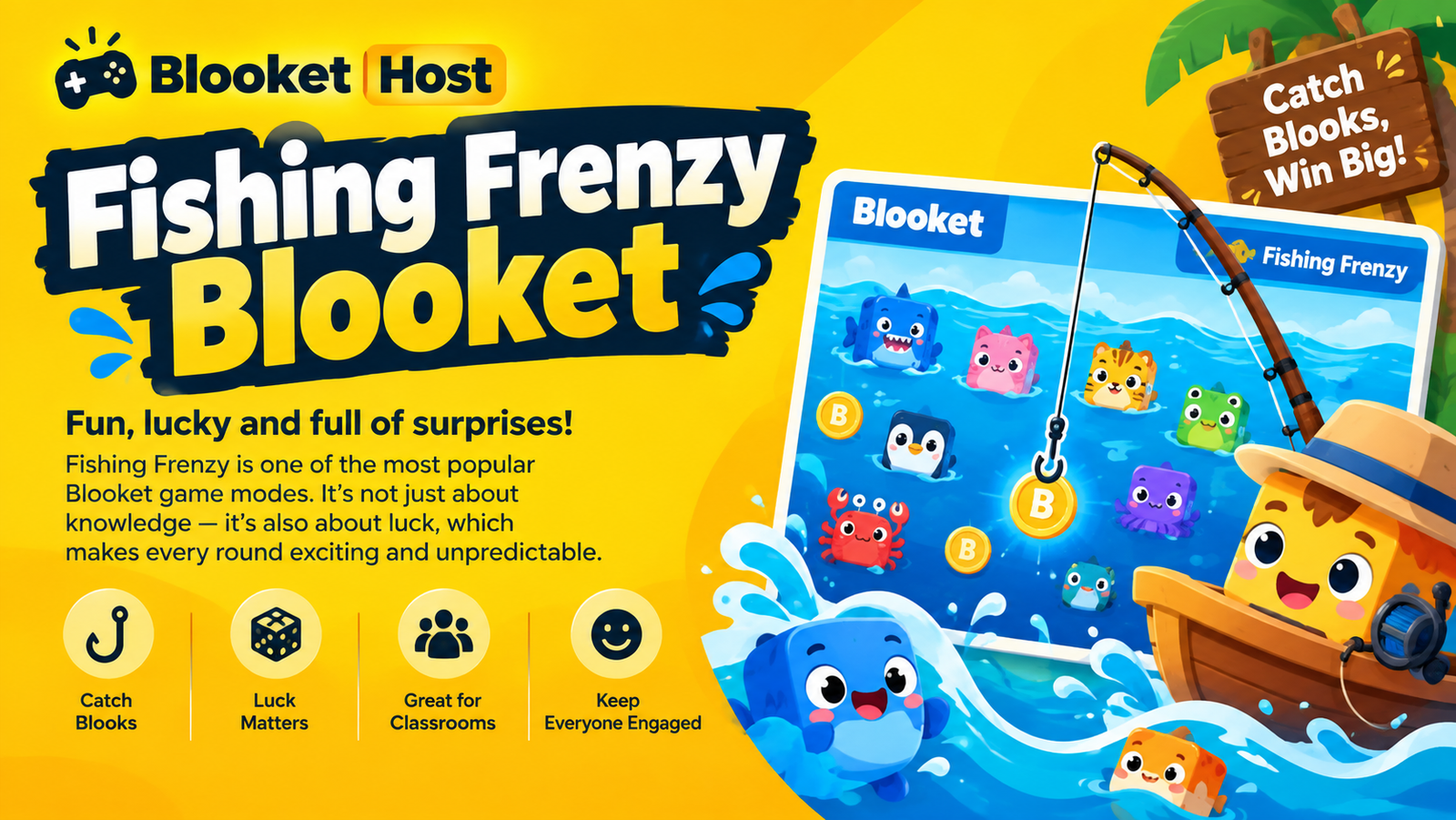
If you’re researching how Fishing Frenzy works in Blooket, you’ve probably already noticed the pattern: it’s one of the modes students ask for by name, session after session. Unlike straightforward trivia formats where the smartest or fastest player wins every time, Fishing Frenzy folds in a genuine luck element alongside speed and knowledge — and that single design choice changes the entire energy of the room. This guide breaks down exactly how the mode plays, what actually determines your score, and the strategies that separate a strong catch from an empty line.
What Fishing Frenzy Actually Is
Fishing Frenzy is a game mode where players cast a line, wait for a bite, and answer a question correctly to land whatever they’ve hooked. As you keep fishing, you unlock better lures and start catching rarer, heavier fish, all while competing for the highest total score — measured in pounds of fish caught, not just raw question count. It’s built around a Simple difficulty rating and blends two skills directly: speed and luck, which is exactly why it plays so differently from a purely knowledge-based mode.
The mode is available in both Live sessions (hosted by a teacher in real time) and Solo/Homework mode, so it works equally well as a classroom activity or independent review.
Step-by-Step: How a Round Plays Out
- Cast your line. Click or tap to cast into the water and start the fishing process.
- Wait for a bite. When a fish takes your line, a “Hooked!” notification appears on screen, signaling it’s time to act.
- Reel it in. Click or tap again to begin reeling in whatever you’ve hooked.
- Answer a question. You’ll be prompted with a question from the host’s selected set. Answer correctly, and the fish is landed and added to your catch. Answer incorrectly, and the fish gets away.
- Repeat. The cycle continues — cast, hook, reel, answer — for the duration of the round, with your total catch weight building as you go.
Why the Luck Element Changes the Room’s Energy
In most trivia-only modes, the same handful of consistently fast, consistently accurate students end up dominating the leaderboard every single time. Fishing Frenzy breaks that pattern because what you hook isn’t entirely within your control — a student with strong content knowledge but average luck on which fish bite can still be outpaced by someone who gets a run of heavier catches, provided they’re answering correctly when it counts.
This shift matters for classroom engagement specifically: students who might disengage after falling behind early in a purely skill-based mode tend to stay locked in here, since a lucky stretch of bites can meaningfully close a gap at any point in the round.
Understanding Lures and Progression
As you continue fishing successfully, you unlock better lures over the course of a session. Better lures generally improve your odds of hooking rarer and heavier fish, which is the core progression loop driving the mode — early in a round you’re mostly working with basic gear, and consistent correct answers gradually shift the odds in your favor as better lures come into play.
This progression system is part of why answering quickly and accurately matters even beyond the immediate points from a single fish: it’s also what unlocks the tools that make your later casts more valuable.
Scoring: Why Pounds, Not Just Catch Count
One detail that trips up new players: Fishing Frenzy scores based on total pounds of fish caught, not simply how many fish you’ve landed. This means a player with fewer, heavier catches can out-score a player who’s landed more fish overall but stuck to smaller, lighter catches. Understanding this early changes how you approach the back half of a session — prioritizing chances at rarer, heavier fish becomes more valuable than just maximizing raw catch frequency once your lure progression allows for it.
Strategies That Actually Help
Prioritize accuracy on every hooked fish. Since landing a fish requires a correct answer, a missed question isn’t just a lost point — it’s a lost catch entirely, which directly costs you toward your total weight. Rushing into a wrong answer to “save time” is rarely worth it in a mode where the fish only counts if you land it.
Don’t neglect early casts just because rewards seem small. Since lure progression depends on consistent success over the course of the round, opting out of early opportunities in hopes of a bigger payout later ignores the fact that better lures are earned through the cycle itself, not handed out for free.
Stay engaged through the full round. Because scoring is cumulative and luck-influenced, a slow start doesn’t eliminate your chances the way it might in a purely skill-based mode — a late run of heavier catches can meaningfully shift final standings.
Treat this as a review tool, not just a game. Since every landed fish depends on a correctly answered question, the actual learning reinforcement happens exactly the same way it would in any trivia-based mode — the fishing mechanic is the wrapper, not a replacement for engaging with the content.
Why Teachers Use This Mode for Review
Beyond the appeal for students, Fishing Frenzy works well as a classroom tool because the luck element genuinely levels the playing field without removing the value of content knowledge — students still need to answer correctly to land anything, but the excitement of the fishing mechanic itself keeps a full class engaged in a way a plain quiz format sometimes doesn’t. Its “Simple” difficulty rating also makes it an easy mode to introduce to a class for the first time, since the core loop (cast, hook, answer) is intuitive within the first round.
Live vs. Solo/Homework Mode
The same core mechanics apply in both settings, with the key difference being competitive context:
- Live mode pits students against each other in real time, with the shared leaderboard adding a social, competitive layer to the fishing mechanic.
- Solo/Homework mode lets students work through the same fishing loop independently, at their own pace, which is useful for review outside of class time without the pressure of a live leaderboard.
The Bottom Line
Fishing Frenzy works by combining a simple cast-hook-answer loop with a genuine luck element, scoring players by total pounds of fish caught rather than just raw question count. That blend of speed, luck, and knowledge is exactly why it holds classroom attention differently than a straightforward trivia mode — a slower start doesn’t eliminate anyone’s chances, and consistent correct answers both add to your score directly and unlock the better lures that make later casts more valuable. Whether run live or assigned as homework, it’s a mode built to keep engagement high through the entire round, not just for the players already in the lead.
