

If you’re tired of watching your portfolio swing up and down with every market headline, income stocks might be exactly what you need. They won’t make you rich overnight, but they’ll pay you again and again, quarter after quarter, no matter what the market is doing that day.
This guide breaks down what income stocks actually are, how 5StarsStocks.com approaches this category, and what you should look for before putting your money into one.
What Are Income Stocks, Really?
An income stock is simply a share in a company that sends part of its profit straight back to you, the shareholder, on a regular basis. Most companies do this through cash dividends, usually paid every quarter, though some pay monthly and a few pay yearly.
Think of it this way: a growth company takes its profits and pours them back into the business to expand faster. An income company already has a mature, stable business, so instead of chasing growth, it hands the extra cash to its owners. That’s you.
This is the core idea behind 5StarsStocks.com income stocks: finding companies that have already proven they can generate consistent profit and are willing to share it.
How 5StarsStocks.com Screens These Companies
Not every stock that pays a dividend deserves a spot on your watchlist. A high yield can look tempting on the surface, but if the company can’t actually afford the payout, that dividend gets cut sooner or later, and your income stream disappears with it.
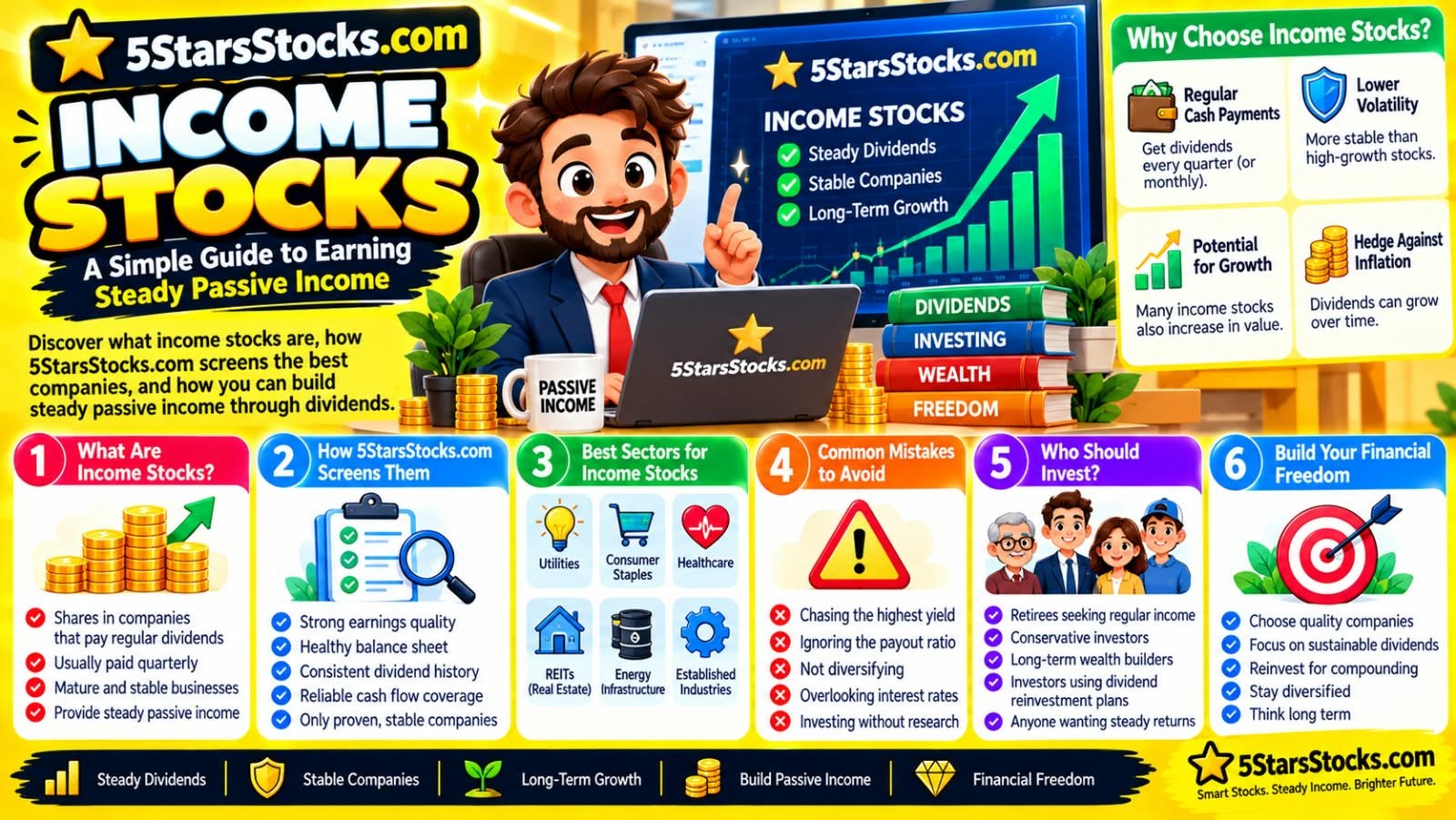
The approach behind 5StarsStocks.com income stocks focuses on a few core things before a company earns a place in this category:
- Earnings quality – Is the profit coming from real, repeatable business activity, or one-time gains that won’t happen again?
- Balance sheet strength – Can the company handle its debt while still paying shareholders?
- Dividend history – Has the payout stayed steady or grown over the years, even during tough markets?
- Cash flow coverage – Does the business generate enough free cash to comfortably cover its dividend, with room to spare?
This is what separates a genuinely reliable income stock from a company that’s simply offering a tempting yield to attract attention.
Why Investors Turn to Income Stocks
There’s a reason income investing has stayed popular for decades, even as flashier growth stocks grab the headlines.
Regular cash in your pocket. You don’t have to sell a single share to get paid. The dividend shows up in your account whether the stock price is up or down that day.
Lower volatility. Income stocks usually belong to mature, established industries like utilities, healthcare, and consumer goods. These businesses don’t swing wildly because demand for their products stays fairly constant.
Room for growth too. A common myth is that income stocks only pay dividends and never go up in price. That’s not true. Many blue-chip dividend payers still see their share price climb over the years, so you get paid and your investment can grow at the same time.
A hedge against inflation. Companies that raise their dividends year after year help your income keep pace with rising costs, something a savings account simply can’t do.
Which Sectors Produce the Best Income Stocks
If you scan through most income-focused portfolios, you’ll notice the same industries showing up again and again:
- Utilities, because people need electricity and water no matter what the economy is doing
- Consumer staples, since demand for everyday goods rarely drops
- Healthcare, which tends to stay steady through recessions
- Real estate investment trusts, known as REITs, which are legally required to pay out most of their profit as dividends
- Energy infrastructure companies, which often sign long-term contracts that guarantee steady cash flow
These sectors don’t grow fast, but that’s the point. Slow, boring, and predictable is exactly what income investors want.
Common Mistakes to Avoid
Chasing the highest yield. A dividend yield of 10% or more should raise a red flag, not excitement. Extremely high yields often mean the market expects a dividend cut, and the stock price has already dropped to reflect that risk.
Ignoring the payout ratio. This tells you what percentage of a company’s earnings goes toward dividends. If a company is paying out more than it earns, that dividend isn’t sustainable.
Skipping diversification. Putting all your money into one sector, even a stable one, still exposes you to sector-specific risk. Spread your income stocks across a few different industries.
Forgetting about interest rates. When interest rates rise, bonds and savings accounts start offering better returns, which can pull money away from dividend stocks and pressure their prices lower.
Who Should Consider Income Stocks
Income stocks tend to work best for:
- Retirees who need regular cash flow without selling off their investments
- Conservative investors who want steady returns without wild price swings
- Anyone using a dividend reinvestment plan to compound their returns over time
- Investors looking to balance a portfolio that’s otherwise heavy in growth stocks
If your goal is quick, aggressive gains, income stocks probably won’t satisfy you. But if you want your money working quietly in the background while you focus on everything else in life, this strategy fits well.
Frequently Asked Questions
What is the difference between income stocks and dividend stocks?
People often use these terms interchangeably, and in most everyday conversations, they mean the same thing. Technically, dividend growth investors focus on companies that consistently raise their payout over time, while income investors focus more on the size of the current yield. Both strategies revolve around getting paid regularly.
Are income stocks safe investments?
They’re generally considered lower risk than growth stocks because they belong to stable, established companies. That said, no stock is completely risk-free. Dividends can be cut, and stock prices can still fall during a downturn.
Can income stocks still grow in value?
Yes. Many income stocks belong to solid, well-run companies whose share prices rise steadily over the years. You get the dividend payments and potential price appreciation at the same time.
How much money do I need to start investing in income stocks?
There’s no minimum requirement. Many brokers now allow you to buy fractional shares, so you can start building an income portfolio with a small amount and add to it over time.
What is a good dividend yield to look for?
Rather than focusing on a single number, look at the whole picture: a sustainable payout ratio, a history of consistent or growing dividends, and solid cash flow. A yield between 3% and 6% is often considered a healthy, sustainable range, though this varies by sector.
Final Thoughts
Income stocks won’t double your money in a year, and that’s exactly the point. They’re built for patience, not speed. By focusing on companies with strong earnings, manageable debt, and a real history of rewarding shareholders, you can build a portfolio that pays you steadily, year after year, regardless of what the headlines say about the market that day.
Tags: income stocks, dividend investing, passive income stocks, 5starsstocks.com, best dividend stocks 2026
Explore More:
How to Navigate Funding for Business Growth: A Founder’s Guide
