

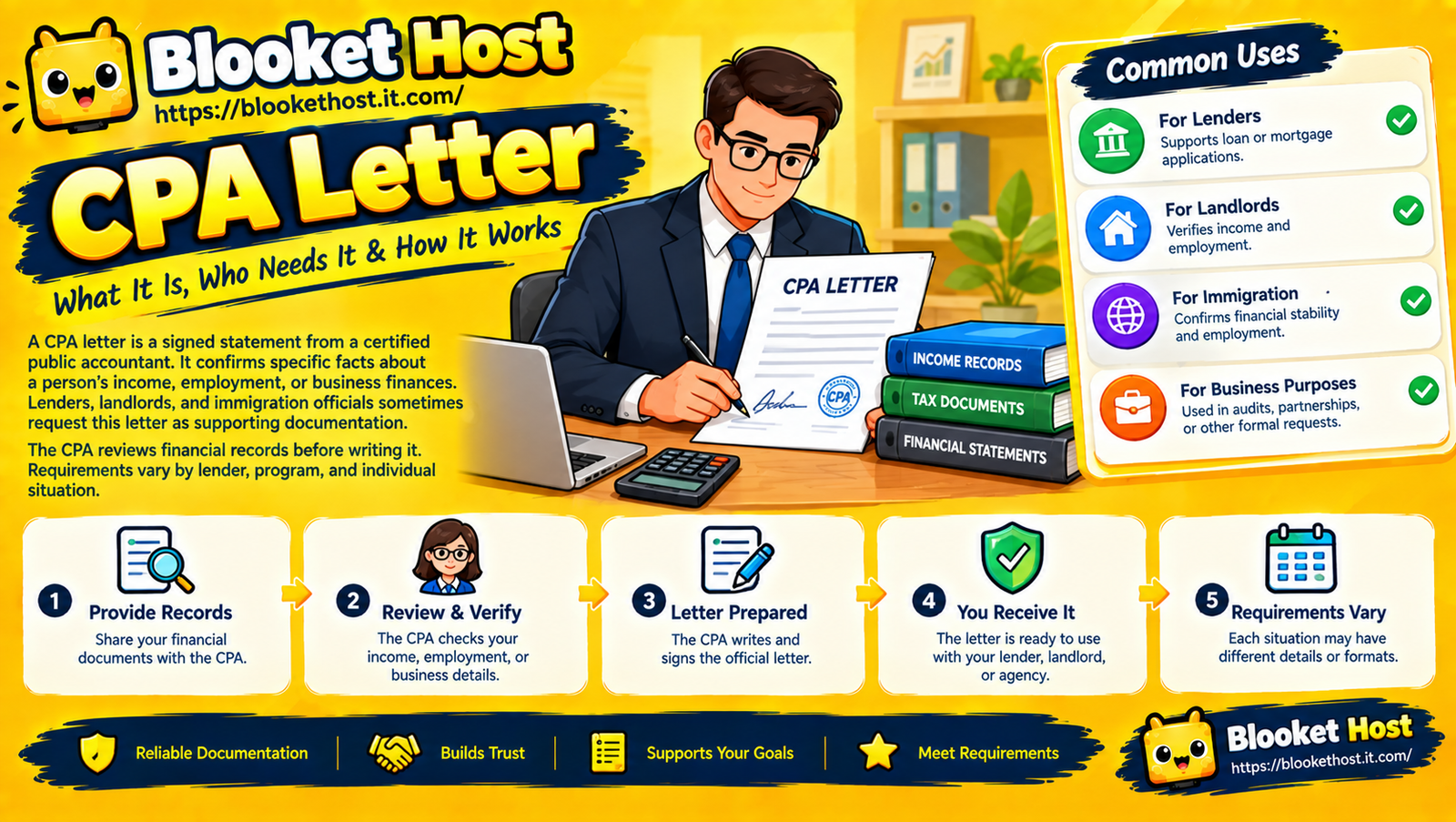
A CPA letter is a signed statement from a certified public accountant confirming specific facts about a person’s income, employment, or business finances. Lenders, landlords, and immigration officials sometimes request this letter as supporting documentation for a larger application or decision. Understanding what a CPA letter is and when you need one can save a lot of back-and-forth once a request for it lands on your desk unexpectedly — since these letters aren’t standardized, and knowing what to ask your accountant for makes the whole process faster.
What a CPA Letter Actually Is
At its core, a CPA letter is a professional attestation. Rather than you simply stating your own income or business standing, a licensed CPA reviews your actual financial records and puts their professional credibility behind a specific set of facts in writing. This matters because it shifts the burden of verification: instead of a lender or agency having to independently confirm your financial claims, they’re relying on a licensed professional who has already reviewed the underlying documentation and is willing to sign their name to the summary.
This is different from a tax return, a pay stub, or a bank statement. Those are raw records. A CPA letter is an interpretation and confirmation of those records, written specifically for the purpose the requesting party needs it for.
Who Typically Requests a CPA Letter
A handful of situations account for the majority of CPA letter requests:
Mortgage lenders. Self-employed borrowers, business owners, or anyone with non-traditional income often can’t demonstrate income the same way a salaried W-2 employee can through simple pay stubs. A CPA letter confirming income stability, business profitability, or self-employment duration is a common substitute or supplement in the underwriting process.
Landlords. For rental applications, particularly for self-employed applicants or those with variable income, a landlord may ask for a CPA letter confirming income level or business standing as an alternative to standard employment verification.
Immigration officials. Certain visa and immigration applications require documented proof of financial stability, business ownership, or income level, and a CPA letter can serve as third-party confirmation of financial claims made in the application.
Business partners or investors. In some transactions, a CPA letter confirming a company’s financial standing or an individual’s business ownership stake provides a level of assurance beyond what internal documents alone would offer.
Loan applications beyond mortgages. Business loans, SBA loans, and certain personal loans for self-employed applicants may also request this kind of third-party financial confirmation.
What’s Typically Included
Because CPA letters are written for a specific purpose rather than following one universal template, content varies. That said, most letters include some combination of:
- The CPA’s confirmation of their professional relationship with the individual or business (how long they’ve served as the accountant, in what capacity).
- A specific statement of the facts being confirmed — income level, self-employment duration, business ownership percentage, or financial stability, depending on what was requested.
- The basis for that confirmation — typically referencing the tax returns, financial statements, or other records reviewed to support the statement.
- The CPA’s license information and signature, since the letter’s credibility rests entirely on it coming from a verifiably licensed professional.
- A specific date and, often, a statement about the letter’s intended use, since CPA letters are usually written for one particular purpose rather than as a general-use document.
What a CPA Letter Is Not
A few common misconceptions are worth clearing up:
It’s not a guarantee of loan approval. A CPA letter is documentation the lender or agency considers as part of their own decision-making process — it doesn’t override their underwriting criteria or guarantee any specific outcome.
It’s not the same as an audited financial statement. An audit is a much more extensive, formal process with its own standards and higher cost. A CPA letter is typically a narrower, more targeted confirmation of specific facts rather than a full audit opinion.
It’s not something any accountant can write casually. Because the CPA is putting their professional license behind the statement, most CPAs will actually review relevant records before agreeing to write one — this isn’t a rubber-stamp document, and a reputable CPA won’t sign one without doing that underlying review.
How to Request One From Your Accountant
If you’ve been asked to provide a CPA letter, here’s a practical approach to getting one prepared efficiently:
- Get the exact requirements from whoever is asking for it. Different lenders, landlords, or agencies often have specific language, formatting, or content requirements. Passing this directly to your CPA saves back-and-forth revisions.
- Provide your CPA with the request in writing, ideally the exact letter or form from the requesting party, rather than a verbal summary of what’s needed.
- Gather the relevant financial records your CPA will need to review — tax returns, financial statements, business records — before your meeting, so the process isn’t delayed by scrambling for documents afterward.
- Ask about turnaround time upfront. Since CPAs need to actually review records rather than just signing a template, factor this into any deadline you’re working against.
- Clarify the letter’s stated purpose with your CPA. A letter written for a mortgage lender may need different framing than one written for an immigration application, even if the underlying facts are similar.
Costs and Turnaround Expectations
CPA letters aren’t typically free — most accountants charge a fee for the time spent reviewing records and drafting a formal, signed statement, even for existing clients. Cost varies significantly based on the complexity of what’s being confirmed and how much record review is required; a straightforward income confirmation for an existing, well-documented client is generally quicker and less expensive than a more complex letter involving business ownership structure or multi-year financial trends.
Turnaround time also varies by CPA workload and complexity, so requesting one as early as possible in whatever larger process requires it — rather than waiting until a deadline is imminent — avoids unnecessary pressure on both you and your accountant.
A Note on Requirements Varying by Situation
It’s worth repeating what’s often the most important practical point: requirements for a CPA letter vary meaningfully by lender, program, and individual circumstance. A mortgage lender’s exact language expectations may differ from an immigration program’s, and even two mortgage lenders can have different specific requirements. Always confirm the exact requirements directly with whoever is requesting the letter before your CPA drafts it, rather than assuming a generic version will satisfy every situation.
The Bottom Line
A CPA letter is a targeted, professionally signed confirmation of specific financial facts — income, self-employment status, or business standing — used to support applications where standard documentation like pay stubs doesn’t fully tell the story. Whether you’re dealing with a lender, a landlord, or an immigration application, the process comes down to the same basics: get the exact requirements from the requesting party, bring them directly to your CPA along with the relevant financial records, and build in enough time for an actual review rather than treating it as an instant, same-day document. Since requirements genuinely differ by situation, confirming specifics upfront is what prevents a letter from needing to be redone after the fact.
