

Every growing business hits the same wall sooner or later. Sales are climbing, customers keep coming back, and the team is stretched thin. That’s when the money question shows up: where do you find the cash to grow without losing control of what you built?
Funding is not just about getting a check. It’s about picking the right kind of money for the stage your business is in. The wrong choice can cost you equity you didn’t need to give away, or lock you into debt you can’t service yet. The right choice buys you time and momentum.
This guide walks through the main funding paths available today, how to know which one fits your business, and what investors and lenders actually look for before they say yes.
Why Funding Decisions Matter More Than the Amount
Founders often chase the biggest number on the table. That’s a mistake. A $500,000 investment that costs you 20% of your company is not automatically better than a $200,000 loan you can pay off in three years.
Recent data backs this up. Deal activity in early 2026 picked up compared to the year before, with startups raising over $30 billion in a single quarter through tracked platforms. But the deals that closed fastest weren’t the flashiest pitches. They went to founders who showed real revenue, steady growth, and a clear plan for the money.
Investors today ask a simple question: will this dollar produce another dollar in return, and how fast? If your answer is vague, funding gets harder no matter how big the round is.
Start With Your Own Numbers
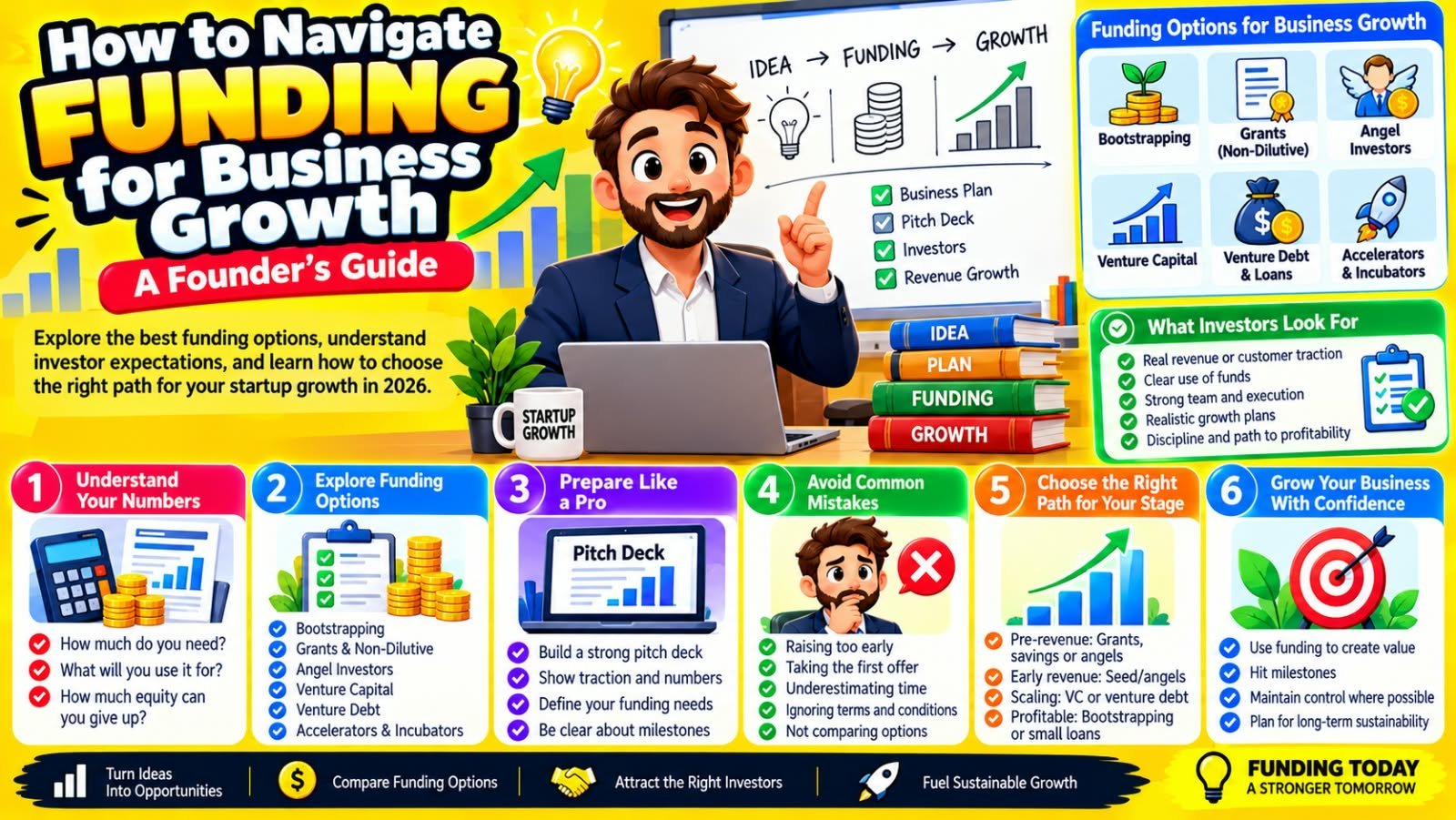
Before you approach anyone with money, work out three things.
How much do you actually need? Not a round number that sounds good in a pitch, but a figure tied to specific goals like hiring two engineers, buying stock, or entering a new market.
What will you use it for? Lenders and investors both want to see the money mapped to outcomes, not sitting in a bank account with no plan.
How much of your business are you willing to give up, if any? This decision shapes every other choice you make next.
Update your business plan into a growth plan once you’ve answered these. Treat it as a financial forecast, not a pitch document. Talk it through with an accountant or a financing advisor before you talk to anyone else.
The Main Funding Paths and When to Use Each
Bootstrapping
This means funding growth from your own revenue and savings. It keeps full ownership in your hands and forces discipline, since every dollar spent has to earn its place. It works well for businesses with steady cash flow and slower, controlled growth plans. It struggles when you need to move fast against competitors who are raising outside money.
Grants and Non-Dilutive Funding
Grants from government programs or foundations don’t cost you any equity. The catch is that they come with strict criteria, take time to apply for, and are usually capped at amounts too small to fund major growth on their own. They work best as a supplement, not your main funding source. Programs like the Small Business Credit Initiative are a good starting point to search.
Angel Investors
Angels are individuals investing their own money, usually at the earliest stage, in exchange for equity or a convertible note. They tend to move faster than institutional investors and often bring mentorship along with the check. Platforms like AngelList make it easier to find and connect with them directly.
Venture Capital
VC funding suits businesses built for fast, large scale growth, not steady small business growth. In 2026, the median seed round sits around $4 million, and Series A rounds average close to $15 million. VCs expect a clear path to a big market and are increasingly asking for proof of real revenue before they commit, not just a strong story.
Building a relationship with a VC firm before you need the money puts you in a stronger position when you finally ask.
Venture Debt and Other Debt Financing
Debt financing has grown fast recently, now making up more than 60% of disclosed funding deals in some quarters. It lets you extend your runway without giving up ownership, which makes it attractive once you already have predictable revenue coming in. The risk is repayment pressure if growth slows down.
Incubators and Accelerators
These programs offer mentorship, office space, and introductions to investors, often in exchange for a small equity stake. They suit early businesses that need structure and network access more than a large check right away.
What Investors and Lenders Actually Check
Regardless of which path you pick, a few things come up again and again in due diligence.
- Consistent revenue or a clear customer base, even if small
- A realistic growth rate backed by real numbers, not projections alone
- A defined use of funds, tied to specific milestones
- A team that can execute the plan, not just describe it
- Awareness of your own risk, including what happens if growth slows
One thing has changed clearly in 2026: growth alone no longer impresses investors. They want growth paired with discipline, meaning controlled spending and a visible path toward profitability, not growth funded by endless cash burn.
A Simple Way to Match Funding to Your Stage
If you’re pre-revenue, grants, personal savings, or a small angel round usually make more sense than chasing venture capital too early.
If you have early revenue and steady customers, angel investors or a seed round fit better, since you can now show traction instead of just an idea.
If you have predictable revenue and need to scale fast, venture capital or venture debt both become realistic options, depending on how much ownership you’re willing to trade for speed.
If your revenue already covers most costs, bootstrapping combined with a small debt facility often gets you further than a large equity round would, and it keeps more of the company in your hands.
Common Mistakes Founders Make
Many founders raise money before they’ve proven the business actually needs it. Others take the first offer on the table instead of comparing terms across a few options. A common one is underestimating how long fundraising takes; the average gap between funding rounds now stretches to well over two years, so waiting until you’re almost out of cash to start raising is risky.
Rejection is also just part of the process. It’s common for founders to hear no more than a dozen times before getting a yes, so one rejection doesn’t mean the business isn’t fundable.
Final Thoughts
Navigating funding for growth isn’t about finding the biggest check available. It’s about matching the right kind of money to the stage your business is actually in, and being honest with yourself about how much control you’re willing to trade for speed. Do the numbers first, understand your options clearly, and only then start the conversations with investors or lenders.
Frequently Asked Questions
What is the best type of funding for a small growing business?
It depends on your cash flow. If revenue is steady, debt financing or bootstrapping usually costs less in the long run than giving up equity.
How much equity should I give up for funding?
There’s no fixed rule, but most founders aim to keep majority control through early rounds. Discuss this with an advisor before negotiating.
Is it better to bootstrap or raise venture capital?
Bootstrapping keeps ownership but limits speed. Venture capital speeds up growth but comes with investor expectations and reduced ownership. The right answer depends on how fast your market is moving.
How long does it take to raise funding?
It varies widely, but founders should expect the process to take several months from first investor meeting to funds in the bank, and often longer for larger rounds.
Do I need a perfect pitch deck to get funding?
A polished deck helps, but investors care more about real numbers, a clear market, and a capable team than design quality alone.
Explore More:
Coyyn.com Review: What This Digital Finance Site Really Offers
