

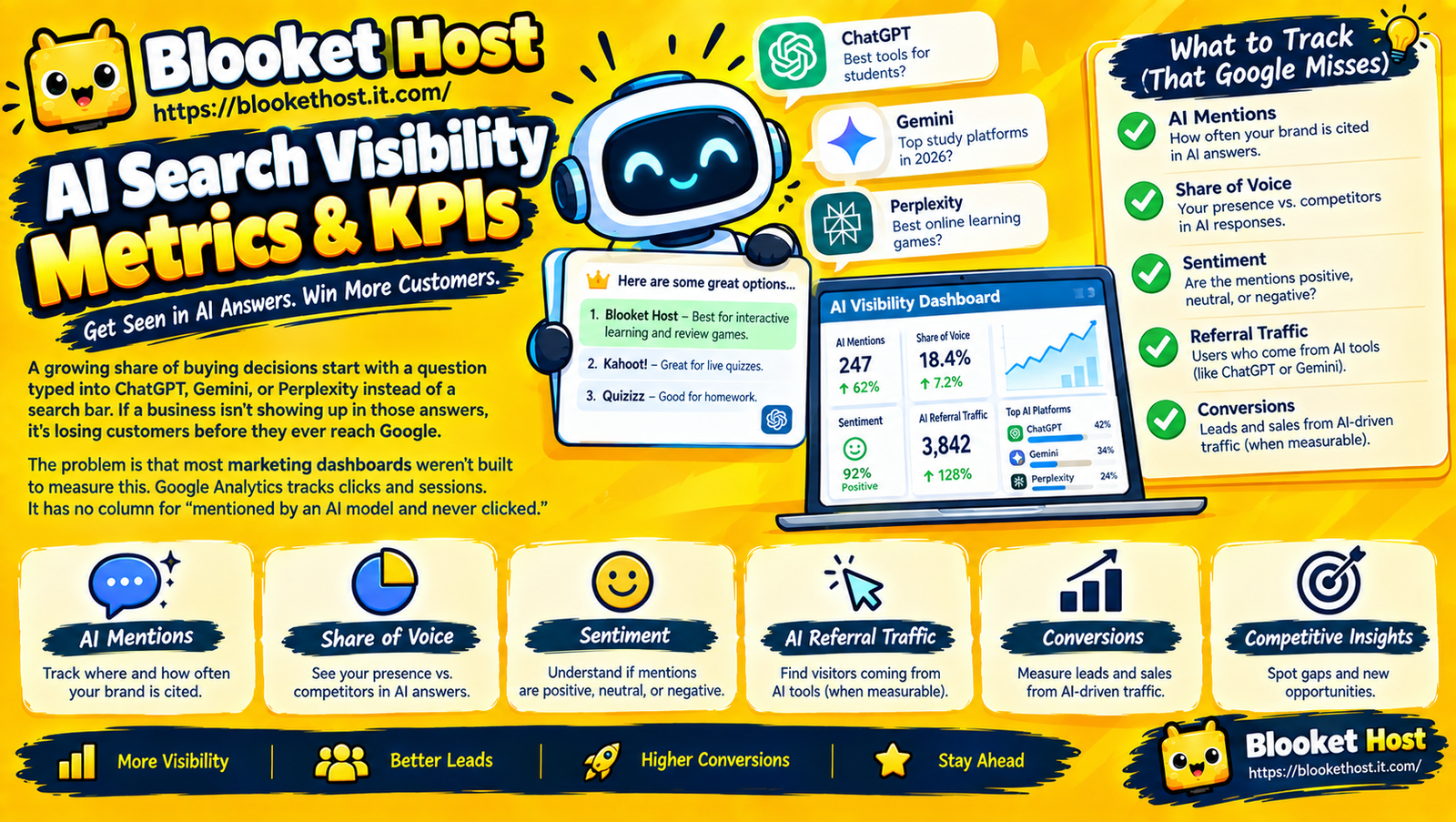
A growing share of buying decisions start with a question typed into ChatGPT, Gemini, or Perplexity instead of a search bar. If a business isn’t showing up in those answers, it’s losing customers before they ever reach Google. Figuring out the right AI search visibility metrics and KPIs to track is the first real problem to solve here, because most marketing dashboards weren’t built for this shift. Google Analytics tracks clicks and sessions — it has no column for “mentioned by an AI model and never clicked.” This guide walks through the metrics that actually matter for understanding whether your brand is visible in this new layer of search, and how to start tracking them.
Why Traditional Analytics Miss This Entirely
Google Analytics, Search Console, and most SEO platforms were built around a specific model: a user searches, sees a list of links, clicks one, and lands on your site where a pixel fires and an event gets logged. AI-driven search breaks that model at the first step. A user asks an AI assistant a question, gets a synthesized answer that may reference your brand, product, or content — and never clicks anything at all. From your analytics’ perspective, that interaction simply doesn’t exist, even though it may have directly influenced a purchase decision.
This creates a real measurement gap: the influence is happening, but the tools built for click-based attribution have no mechanism to capture it.
Core Metric: Share of Model (Brand Mention Frequency)
The most foundational metric in this space is often called Share of Model or brand mention frequency — essentially, how often your brand, product, or content gets surfaced when relevant questions are asked across major AI assistants.
Tracking this typically involves:
- Running a consistent set of representative queries across ChatGPT, Gemini, Perplexity, and other relevant assistants on a regular cadence.
- Logging whether your brand appears, and in what context (recommended, mentioned neutrally, mentioned negatively, or absent entirely).
- Comparing that frequency against competitors asked the same or similar questions.
This is the closest AI-era equivalent to tracking keyword rankings in traditional SEO — except instead of a ranked list of ten blue links, you’re measuring presence within a single synthesized answer.
Citation Rate: Are You the Source Behind the Answer?
Beyond simply being mentioned, a more granular metric is citation rate — how often an AI assistant’s answer actually links back to or explicitly cites your content as its source. Many AI search tools (Perplexity in particular) show source citations alongside generated answers, which gives you a more concrete, trackable signal than a mention buried inside generative text with no attribution at all.
A high citation rate suggests your content is being treated as a trusted, referenceable source — which matters both for direct traffic from clicked citations and as a strong proxy for how AI models are weighting your content’s authority on a given topic.
Sentiment and Framing of AI Mentions
Being mentioned isn’t automatically a good thing — how you’re mentioned matters just as much. This metric tracks:
- Positive framing — recommended, praised, or presented as a strong option.
- Neutral framing — mentioned factually without any qualitative judgment.
- Negative framing — mentioned alongside criticism, complaints, or unfavorable comparisons.
Since AI assistants often synthesize sentiment from review sites, forums, and public content about your brand, negative framing in AI answers can be a signal worth investigating — it may reflect underlying reputation issues showing up in the source material AI models are drawing from.
Answer Presence Across Query Intent Categories
Rather than tracking visibility as one flat number, breaking it down by query intent gives a much clearer picture of where you’re strong and where you’re invisible:
- Informational queries (“what is X,” “how does X work”) — are you cited as an educational source?
- Comparison queries (“X vs Y,” “best X for Z”) — are you included in the comparison set at all?
- Transactional queries (“where to buy X,” “X pricing”) — are you surfaced when someone is close to a purchase decision?
A brand might have strong visibility in informational queries but be entirely absent from comparison queries, which points to a very different content gap than the reverse pattern would.
Content Structure Signals as Leading Indicators
Since AI models pull from structured, well-organized content more reliably than dense, unstructured pages, a few on-page factors function as leading indicators for future visibility, even before you see a measurable change in mention frequency:
- Clear, direct answers to specific questions near the top of relevant content.
- Structured data and schema markup that make content easier for models and crawlers to parse accurately.
- Consistent, unambiguous brand and product naming across your site, reducing the chance of a model misattributing or confusing your offering with a competitor’s.
These aren’t traffic metrics themselves, but tracking improvements here alongside mention frequency helps establish whether specific content changes are actually moving the needle.
Referral Traffic from AI Platforms
While much of AI search happens without a click, a growing share of AI tools do include clickable citations or “read more” links. Where this exists, referral traffic from AI platforms is a trackable metric in most standard analytics setups — it just requires knowing what to look for.
Checking your existing traffic source reports for referrals from domains associated with AI assistants (where visible) gives you a partial, but real, picture of AI-driven traffic that’s often buried unnoticed in a “referral” or “other” bucket rather than broken out as its own category.
Building a Simple Tracking Cadence
None of these metrics are useful as one-time snapshots — the value comes from consistent, repeated measurement over time. A practical starting cadence looks like:
- Define a fixed set of representative queries covering informational, comparison, and transactional intent relevant to your business.
- Run those queries monthly across the major AI assistants relevant to your audience.
- Log mention presence, framing, and citation status for each query.
- Track referral traffic from AI sources in your existing analytics as a supplementary signal.
- Review content structure on pages tied to queries where visibility is weak or absent.
The Bottom Line
Measuring AI search visibility requires stepping outside the click-based framework that traditional analytics tools were built around. Mention frequency, citation rate, sentiment framing, and intent-based presence give a far more accurate picture of whether your brand is actually showing up where a growing share of buying decisions now begin — even when none of that activity would ever register as a session in Google Analytics. Building a consistent tracking cadence around these metrics now puts a business ahead of competitors still measuring an entirely different, increasingly incomplete part of the search landscape.
