

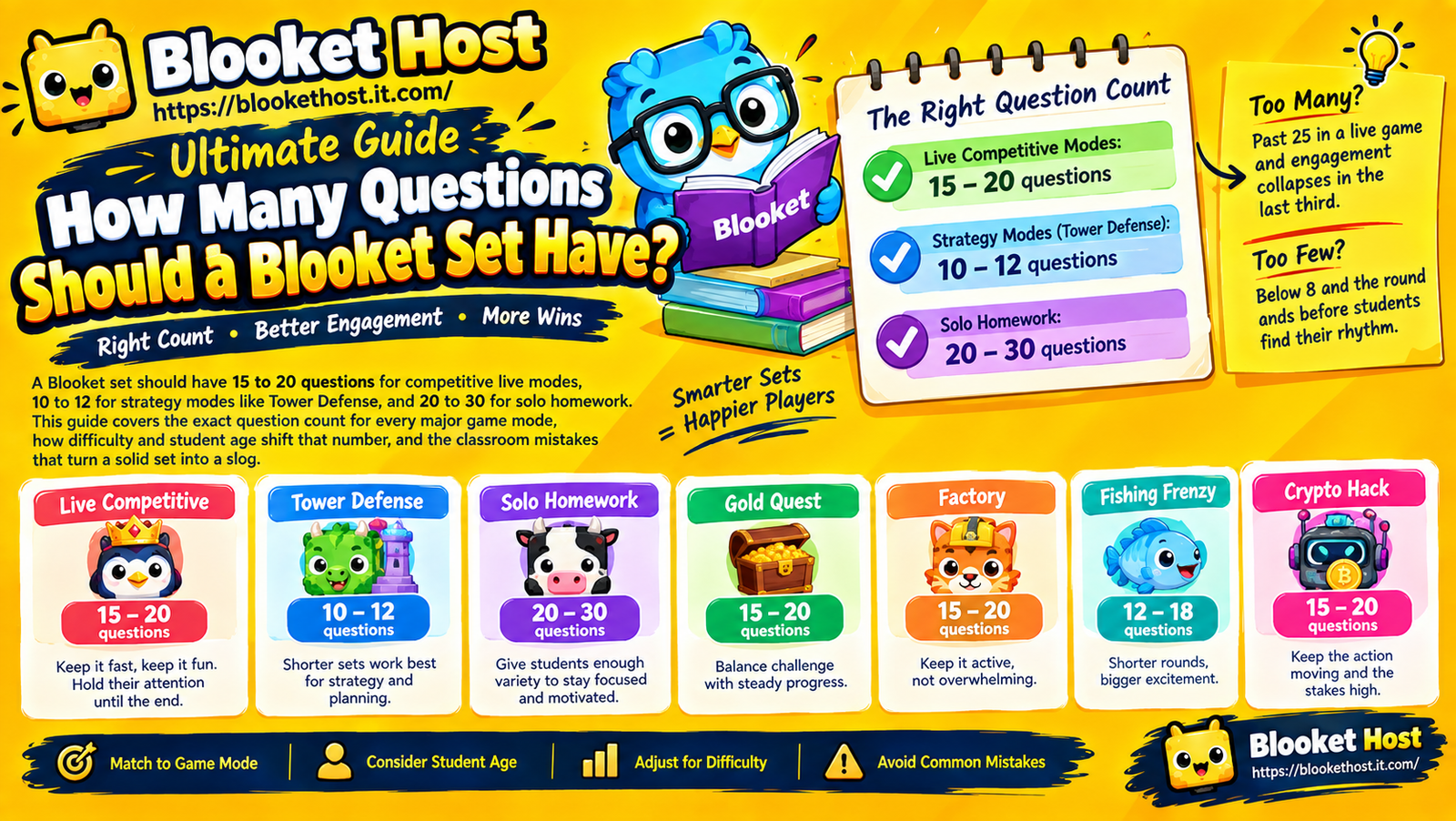
A blocket.com set should have 15 to 20 questions for competitive live modes, 10 to 12 for strategy modes like Tower Defense, and 20 to 30 for solo homework sets. Push past 25 questions in a live game and you’ll watch engagement collapse in the last third. Go below 8 and the round ends before students settle into a rhythm. Knowing how many questions a Blooket set should have isn’t just a matter of preference — it’s the single most overlooked variable in whether a hosted game actually holds a classroom’s attention from start to finish. This guide covers the exact count for every major mode, how difficulty and age shift that number, and the mistakes that turn a solid set into a slog.
Why Question Count Matters More Than People Think
Teachers spend a lot of time picking the right topic and difficulty for a set, but question count gets treated as an afterthought — usually just “however many questions I happened to write.” That’s a mistake. Pacing is directly tied to count: too few questions and the round ends abruptly, right as students are getting into a competitive groove; too many and you’ll watch attention visibly drop in the back third of the game, especially in classes with younger students or shorter attention spans.
The Baseline Numbers by Mode
Different blocket.com modes have fundamentally different pacing, which means the “right” question count isn’t one universal number — it shifts based on what the mode is actually asking of players.
Fast-Paced, Competitive Live Modes
Ideal range: 15–20 questions
Modes built around speed and direct competition thrive in this range. It’s enough to build real momentum and let a leaderboard shift meaningfully, but short enough to keep energy high throughout. Past 25 questions in this format, engagement reliably drops — students who’ve fallen behind start checking out mentally once they sense the round has too much left to catch up.
Strategy-Based Modes (e.g., Tower Defense)
Ideal range: 10–12 questions
Strategy modes ask more of players per question — resource management, timing decisions, planning — which means each question carries more cognitive load than a pure speed-and-recall format. A shorter question count compensates for that, keeping the strategic layer from becoming exhausting rather than engaging. Stretching a strategy mode to 20+ questions often turns an interesting mechanic into a grind.
Solo Homework Sets
Ideal range: 20–30 questions
Solo play doesn’t carry the same live-pacing pressure as a hosted classroom session. Since students are working through it independently and can stop or return to it, a longer set is appropriate here — and often preferable, since it gives more comprehensive topic coverage for review purposes without the same risk of “engagement collapse” that a live group session faces.
How Difficulty Shifts These Numbers
The baseline ranges above assume moderate difficulty. Adjust from there based on how challenging your actual content is:
Harder content → fewer questions. If your set covers genuinely difficult material requiring real thought per question, trim toward the lower end of whatever range fits your mode. Cognitive fatigue sets in faster with harder content, so a 20-question set of tough conceptual questions can feel far longer than a 20-question set of quick recall facts.
Easier content → you can push toward the higher end. Simple recall or vocabulary-style questions move fast, so a slightly higher count within your mode’s range typically doesn’t hurt pacing the way it would with denser material.
How Age Shifts These Numbers
Younger students generally need shorter sets across every mode. A live competitive game that works well at 18 questions for older students might need to drop closer to 12–14 for younger grades, simply because attention spans and processing speed per question differ meaningfully by age group. If you’re unsure where your class falls, erring shorter is almost always the safer mistake — a set that ends a little early leaves room to run a second round, while a set that drags leaves you fighting to re-engage a class that’s already checked out.
Common Mistakes That Turn a Good Set Into a Slog
Building the set around content coverage instead of pacing. It’s tempting to include every question you can think of on a topic, but a blocket.com set isn’t meant to be exhaustive — it’s meant to hold attention while reinforcing key material. If you have more content than your mode’s ideal range supports, that’s usually a sign you need two shorter sets rather than one long one.
Ignoring mode-specific pacing. A question count that works great for a fast-paced live mode can completely sink a strategy mode, and vice versa. Copy-pasting the same 25-question set across every mode you host is one of the most common ways engagement quietly drops without an obvious cause.
Not accounting for real classroom time. Question count and available class time need to match. A 20-question live set that’s rushed into a 10-minute window creates a different kind of engagement problem than pacing alone — students feel hurried rather than challenged, which is a separate issue from the set simply being too long.
Assuming homework-length sets work for live games. The 20–30 question range that’s appropriate for independent solo review is often too long for a live, competitive session. What works when a student can pause and return later doesn’t necessarily hold up when the entire class is moving through it together in real time.
A Quick Reference
| Mode Type | Ideal Question Count |
|---|---|
| Fast-paced/competitive live modes | 15–20 |
| Strategy-based modes (Tower Defense, etc.) | 10–12 |
| Solo homework sets | 20–30 |
Adjust down for harder content or younger students; adjust up (within range) for easier content or older groups.
The Bottom Line
Question count isn’t a minor detail — it’s a direct pacing lever that determines whether a hosted game holds a class’s attention from the first question to the last. Live competitive modes hold their energy best in the 15–20 range, strategy modes need a tighter 10–12 to avoid cognitive fatigue, and solo homework sets can comfortably stretch to 20–30 since there’s no live-pacing pressure involved. When in doubt, especially with younger students or denser material, trimming toward the shorter end of whatever range fits your mode is almost always the safer call than pushing a set too long and watching engagement fall apart in the back third.
