

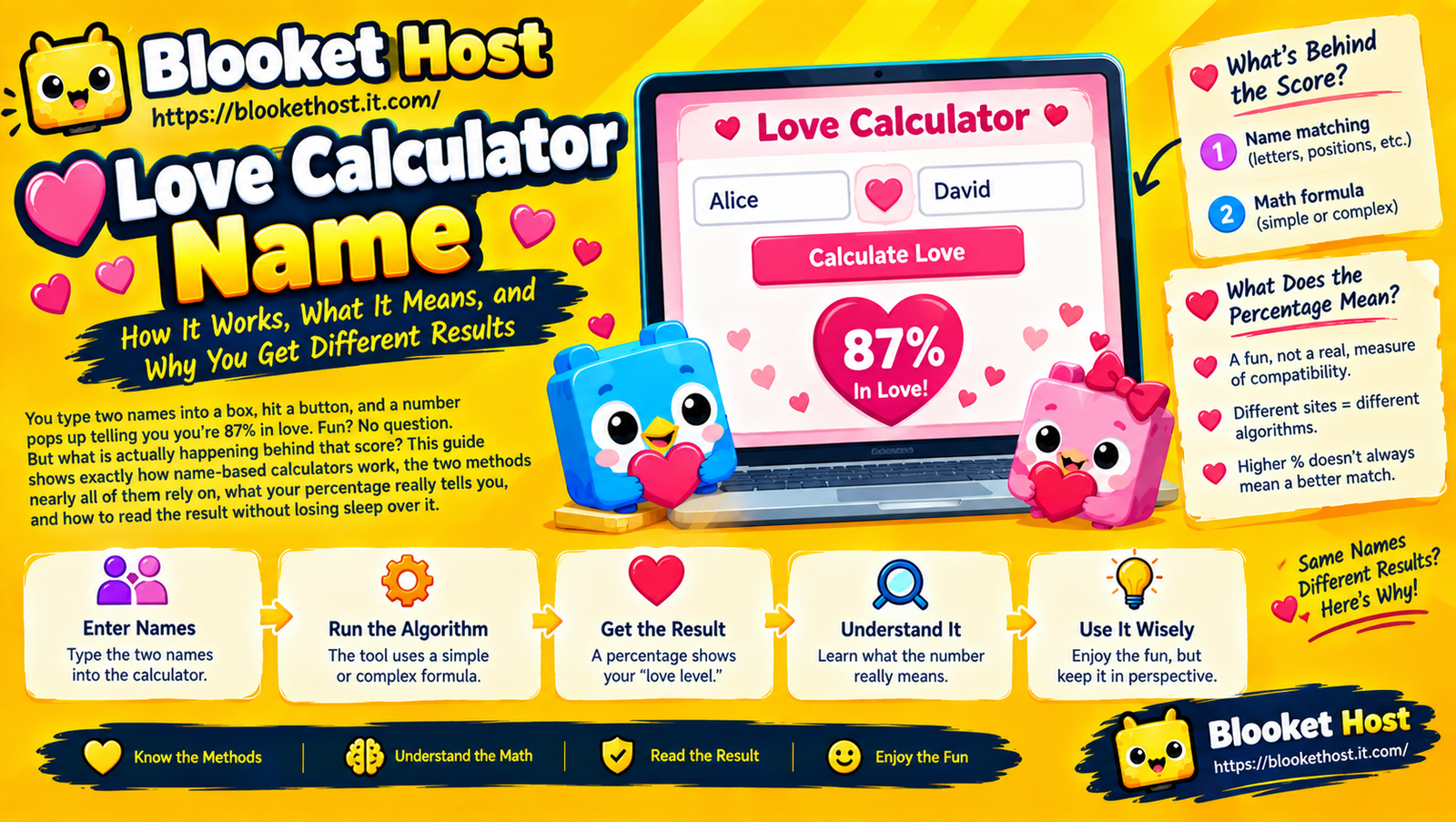
You type two names into a box, hit a button, and a number pops up telling you you’re 87% in love. Fun? No question. But what’s actually happening behind that score? Most people use a love calculator by name without ever knowing how it reaches its answer, what the result means, or why two different sites hand you two different numbers for the same couple. This guide traces the math back to the actual methods that power these tools, so by the end, you’ll understand the calculator better than most of the sites hosting it.
The Honest Starting Point: It’s Not Measuring Love
Before getting into the mechanics, it’s worth being upfront about something these sites rarely say outright: a name-based love calculator isn’t measuring compatibility, chemistry, or anything about your actual relationship. It’s a deterministic algorithm that takes two strings of text (your names) and converts them into a number through a fixed mathematical process. The entertainment value is real — the “measurement” behind it isn’t.
That doesn’t make it pointless. Understanding exactly how the number is generated is genuinely interesting, and it explains a lot of the quirks people notice, like why the same two names always produce the same score no matter how many times you try, or why swapping name order sometimes changes the result.
Method One: The Classic “FLAMES” Approach
One of the oldest and most widely used methods behind name-based calculators traces back to a game called FLAMES, which predates most online calculators entirely. Here’s the general process:
- Combine both names into one continuous string of letters.
- Cancel out matching letters between the two names, one pair at a time, until no more matches remain.
- Count the remaining letters.
- Use that final count to cycle through the letters F-L-A-M-E-S (standing for Friends, Lovers, Affectionate, Marriage, Enemies, Siblings), eliminating letters in a repeating count-based pattern until only one remains.
- The final letter left determines your “result category” — which many modern calculators then convert into a percentage rather than a category label.
This method is entirely deterministic — given the same two names, it produces the exact same result every single time, since there’s no randomness involved at any step. It’s essentially a structured letter-counting game dressed up as a compatibility tool.
Method Two: Numeric/Hash-Based Scoring
The second common approach, especially on sites that show a clean percentage rather than a category, relies on a numeric conversion process:
- Convert each letter in both names into a corresponding number, often based on standard letter-to-number mapping (A=1, B=2, and so on) or a more complex numerology-style system.
- Sum or combine these numeric values across both names using a fixed formula.
- Run that combined number through a formula designed to compress the result into a percentage range, typically 0–100%.
- Display the final percentage as your “love score.”
Because this method relies on letter-to-number conversion and a fixed formula, it’s also fully deterministic. The specific formula varies by site, which is exactly why plugging the same two names into different calculators can produce different results — they’re not measuring the same thing, they’re running different math on the same input.
Why Two Sites Give You Two Different Numbers
This is one of the most common points of confusion, and the answer is simple once you understand the mechanics above: there’s no single standardized formula behind love calculators. Some sites use the FLAMES method and convert the category into an arbitrary percentage range. Others use a numeric hashing approach with their own custom formula. Some blend elements of both, or add extra factors like birth date to the calculation.
Since each site’s underlying formula differs, feeding the same two names into multiple calculators is mathematically guaranteed to produce different results — not because your compatibility genuinely changed between browser tabs, but because you’re running the same input through entirely different math.
Why the Result Is Always the Same for the Same Names
If you’ve ever tested a calculator by entering the same two names repeatedly, you’ve probably noticed the score never changes. That’s because these tools contain no randomness at all — the entire process is a fixed function of the input text. Given identical names entered the same way, the output will always be identical, every single time, on every device, indefinitely. This is a helpful thing to know if you’re tempted to “try again” hoping for a better number — the math simply won’t produce a different answer without different input.
Does Name Order or Spelling Change the Result?
Yes, in most implementations. Because these algorithms process the input as raw text, several small factors can shift the outcome:
- Which name is entered first can matter, particularly in FLAMES-style calculators where the letter-cancellation process isn’t symmetrical.
- Spelling variations (a nickname versus a full legal name, for instance) produce a different letter set entirely, which changes the result even though it’s referring to the same person.
- Capitalization and spacing occasionally affect results on poorly built calculators, though most modern versions normalize this before processing.
If you’ve seen your score shift after tweaking how a name was entered, this is why — you technically fed the algorithm different input, even if the underlying person or relationship didn’t change.
How to Actually Read Your Result
Given everything above, the healthiest way to interpret a love calculator score is as a lighthearted novelty rather than any kind of genuine insight. A few grounded takeaways:
- A high percentage doesn’t validate a relationship, and a low one doesn’t undermine a good one. The number reflects a fixed formula applied to text, not any real-world dynamic between two people.
- It’s genuinely fun as a shared activity — testing names with friends, seeing which combinations produce funny results, or just enjoying the novelty of a percentage attached to something silly.
- It’s not worth overthinking. Since the algorithm is deterministic and arbitrary, there’s no reason to treat a specific number as meaningful information about your actual relationship.
The Bottom Line
A name-based love calculator isn’t secretly measuring compatibility — it’s running your names through one of two common deterministic processes: a letter-cancellation method rooted in the classic FLAMES game, or a numeric conversion formula that compresses your names into a percentage. Neither approach involves any real analysis of your relationship, which is exactly why different sites produce different numbers for the same two names, and why the same input always produces the same output no matter how many times you try. Understanding the mechanics doesn’t make the tool less fun — it just means you’re in on the joke instead of wondering why the math behind it feels so mysterious.
