

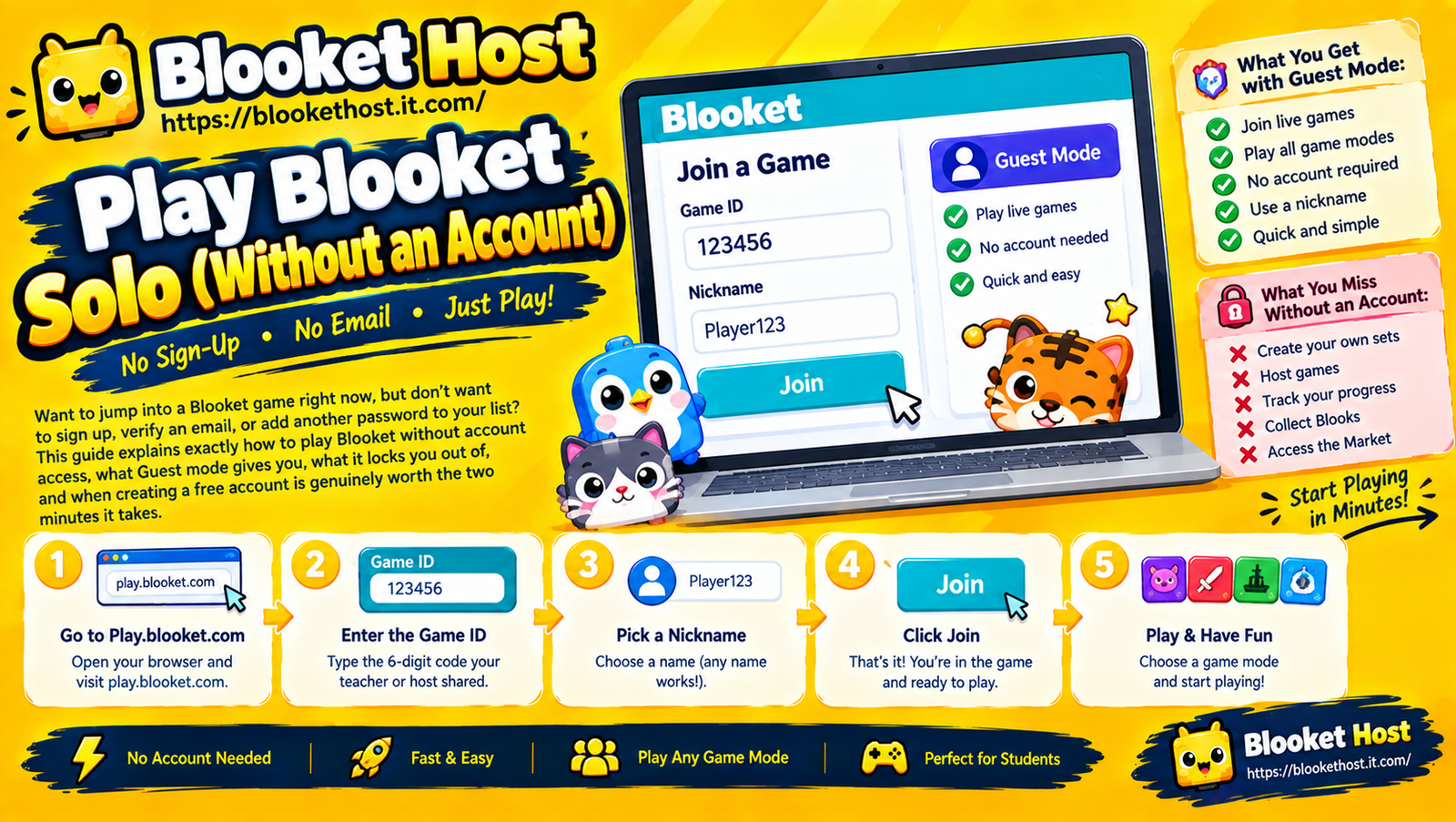
You want to jump into a Solo Blooket game right now, but you don’t want to sign up, verify an email, or add another password to your list. Good news: learning how to play Blooket without an account takes about ten seconds once you know where to go. Head to play.blooket.com, enter the 6-digit Game ID from your teacher or host, pick a nickname, and hit Join. That’s the full flow for live hosted games — no email, no verification, no password required. This guide breaks down what Guest mode actually gives you, what it locks you out of, and when creating a free account is genuinely worth the extra two minutes.
Why Solo Blooket Doesn’t Require an Account to Play
Solo Blooket is built around fast, low-friction classroom sessions, and requiring every student to create an account before joining a game would completely undercut that. Because of this, the platform separates two very different roles:
- Playing (joining a live game) — designed to work instantly, with zero account requirement.
- Hosting or managing content — requires a full account, since it involves saving question sets, tracking data, and managing a dashboard over time.
If your only goal is to join a game someone else is hosting, you’re already covered by the account-free flow. The confusion usually comes from mixing up this player-side experience with the separate login system used for hosting.
Step-by-Step: Joining as a Guest
- Go to play.blooket.com. Type it directly into your browser rather than searching for it, to avoid landing on an unrelated or outdated page.
- Enter the 6-digit Game ID given to you by your teacher or host.
- Choose a nickname. This is temporary and tied only to this session — it doesn’t create any kind of profile or saved identity.
- Click Join. You’ll land in the lobby immediately, no further steps required.
That’s the entire process. From click to joined lobby, it genuinely takes under a minute for most people.
What Guest Mode Actually Gives You
Playing without an account isn’t a stripped-down experience in terms of the actual gameplay — you get full access to:
- The live game itself, including whatever mode the host has selected.
- Real-time competition against other players in the same session.
- Any in-game mechanics specific to that mode — answering questions, earning points or Credits, and interacting with whatever that mode’s format involves.
For the vast majority of one-off players — students joining a classroom review game, or someone jumping into a friend’s session for fun — this covers everything you actually need.
What Guest Mode Locks You Out Of
The tradeoff for skipping account creation is that a few things won’t carry over between sessions:
- No saved token balance. Tokens earned during a guest session aren’t attached to a persistent account, so they won’t be there the next time you play unless you’re logged in.
- No Blook collection. Since Blooks are unlocked through packs purchased with saved tokens, and Guest mode doesn’t retain tokens between sessions, there’s no persistent collection to build over time.
- No hosting ability. Guest access is strictly for joining games other people are running — you can’t create your own sessions or save question sets without a full account.
- No progress tracking across games. Each guest session exists independently; nothing about your performance or activity is remembered once the game ends.
None of this affects the actual experience of playing a single hosted game — it only matters if you’re trying to build something that persists over time.
When Creating a Free Account Is Worth It
Guest mode is genuinely the right call for casual, one-off play. But a free account starts to make more sense once you notice yourself in any of these situations:
You’re playing regularly, not just occasionally. If you’re joining games multiple times a week — whether for a class or just because you enjoy it — an account lets your token earnings actually accumulate instead of resetting with every guest session.
You want to build a Blook collection. Since collection-building depends entirely on saved tokens carrying over between games, this is impossible in Guest mode by design. If pulling rare Blooks and growing a collection is part of what makes the game fun for you, an account is a requirement, not just a nice-to-have.
You want to host your own games. Guest access has no path to hosting. If you ever want to run a session for friends, a study group, or a classroom, creating an account is the only way to unlock that functionality.
You’re a teacher or regular host. This one’s less of a gray area — hosting fundamentally requires an account, since it involves managing saved sets and running a dashboard over time.
Making the Decision
If you’re weighing whether to sign up or just play as a guest right now, a simple gut check usually settles it: are you here for one game, or are you here to keep coming back? One-off play strongly favors Guest mode — it’s faster, it’s frictionless, and you lose nothing meaningful for a single session. Repeated play strongly favors a free account, since the token and collection systems are specifically designed to reward consistency over time, something Guest mode structurally can’t support.
The Bottom Line
Playing Solo Blooket without an account is not only possible, it’s the default, intended way to join most live hosted games — play.blooket.com, a Game ID, a nickname, and you’re in. Guest mode gives you the full gameplay experience for that single session, with no email or password required. The only real tradeoff is persistence: tokens, collections, and hosting ability all require a free account, since those features are built around progress that carries over between sessions rather than a one-time drop-in game. For a quick game right now, Guest mode is the right call. For anything you want to keep building over time, the two minutes it takes to sign up pays for itself fast.
